

When we think of number nine in math, we recall it is a
perfect square, it is the highest digit in the decimal system, and well… It is also the hardest times table to memorize for most people.
Another property of 9 is that it is a composite number, as we will study next.
We will start recalling some definitions that we have widely discussed in our Prime Numbers article. If you still feel unfamiliar with these notions, we invite you to first read that article and come back here later.
A factor of a natural number is a positive divisor of the number. A proper factor of a natural number is a factor that is different from 1 and from the number itself. For example,; thus, 1, 3, 9, 27, and 81 are all factors of 81, but only 3, 9, and 27 are proper factors of 81.
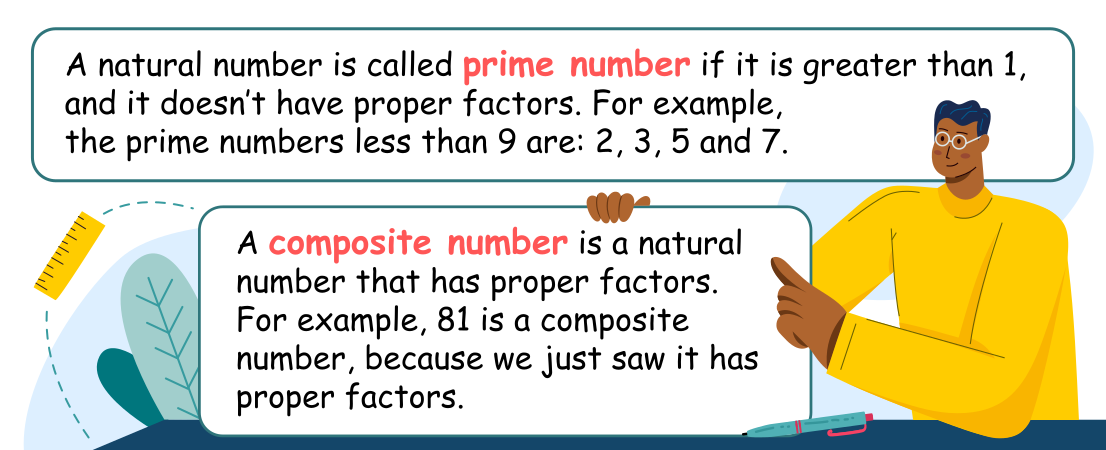
A natural number is called a prime number if it is greater than 1, and it doesn’t have proper factors. For example, the prime numbers less than 9 are 2, 3, 5, and 7.
A composite number is a natural number that has proper factors. For example, 81 is a composite number, because we just saw it has proper factors.
Why is 9 not a prime number?
Nine is not a prime number because it has proper factors: . This is, 3 is a proper factor of 9, which makes 9 a composite number.
Another way of understanding why 9 is not prime, is noticing that it can be split into equal parts, each having more than one element, this is a property that only composite numbers have.

What we can ensure that is a prime number, however, is the square root of 9, because and 3 is prime.
Equivalently, 9 is the square of a prime number, because .

Prime numbers having 9 as a digit
We list below some prime numbers having 9 as one of its digits. This way, you can have them at hand when deciding if some numbers related to 9 are primes.
| The first few prime numbers having 9 as a digit | 19, 29, 59, 79, 89, 97,109 |
We will see why 109 is a prime number, using the following property.
If 𝒏 is a natural number, and neither of the prime numbers less than divides 𝒏, then 𝒏 is a prime number.

Example: We want to verify that 109 is prime.
Notice that 109 < 121, thus .
Therefore, the prime numbers less than are 2, 3, 5 and 7.
Since 109 is not even, 2 doesn’t divide 109. Moreover,
Meaning that neither 3, nor 5 nor 7 divides 109. By the property above, we get that 109 is a prime number.
You can find, on our blog, articles explaining why each of the numbers in the table are primes. We will use that fact in the following example.
Example: The following pairs of numbers have the same digits but in different positions. Which of them are prime numbers?
a) 19 and 91.
b) 39 and 93.
c) 89 and 98.
To see which of the numbers in a) is prime, we first look at the table. We see that 19 is in the table, but 91 is not. Thus, we conclude that 19 is a prime number, and we work on showing that 91 is a composite number.
Notice that:
This means that 91 has proper factors, and therefore it is a composite number.
Thus, among 19 and 91 there is only one prime, which is 19. As you see, the order of the digits does change the result!
For part b), we notice that neither 39 nor 93 is in the table. So, we guess they are both composite numbers. But, guessing is not a formal argument in math!
We need to verify that both numbers have proper factors.
Notice that:
Meaning that 3 and 13 are proper factors of 39, and 3 and 31 are proper factors of 93. In other words, 39 and 93 are both composite numbers.
Finally, for part c), we notice that 89 is in the table, therefore it is a prime number. We also notice that not only 98 is not in the table, but 98 is an even number. Thus, 2 must be a factor of 98:
Since 98 has proper factors, it is not prime, it is a composite number.
In the next article you can read about prime, which is 19.