

Geometry is one of the oldest and important branches of mathematics that deals with the properties of shapes such as lines and angles. Supplementary angles, like vertical and complementary angles, are all pairs of angles.
However, supplementary and complementary angles do not have to be adjacent to each other, unlike vertical angles.
Determining and finding the measures of angles is one of the most commonly performed steps in Geometry. And in order to do so, we need to familiarize ourselves with these geometric terms.
Are you ready to tackle another pair of angles called supplementary angles? Say no more as we dive into another adventure of defining supplementary angles and comparing them to other pairs of angles.
Supplementary angles
Supplementary angles are angles that when added together, their sum is
. Since the sum of their angle measure is, supplementary angles always form a straight line. Using the mathematical sentences, we can say that two angles are supplementary if
Let’s look at one example of supplementary angles.

In the figure, we can see two angles – one measuring and the other angle with measure . If we get the sum of two angles, we will have
Since the sum is exactly , we can say that they are supplementary to each other.
When two angles are supplementary, we call each pair the supplement of the other angle. Hence, in this case, is the supplement of , and vice versa.
More so, if you will notice, the two angles formed a straight line. Just like linear pairs, supplementary angles are pairs of angles that can form a straight line because their sum is .
Types of Supplementary Angles
Like complementary angles, supplementary angles can be adjacent or non-adjacent. Let’s discuss how these two types are different from each other.
Adjacent Supplementary Angles
If two angles share a common vertex and a common side and have a total of
angle measure when combined, then they are said to be adjacent supplementary angles.
Let’s take a look at these illustrations.
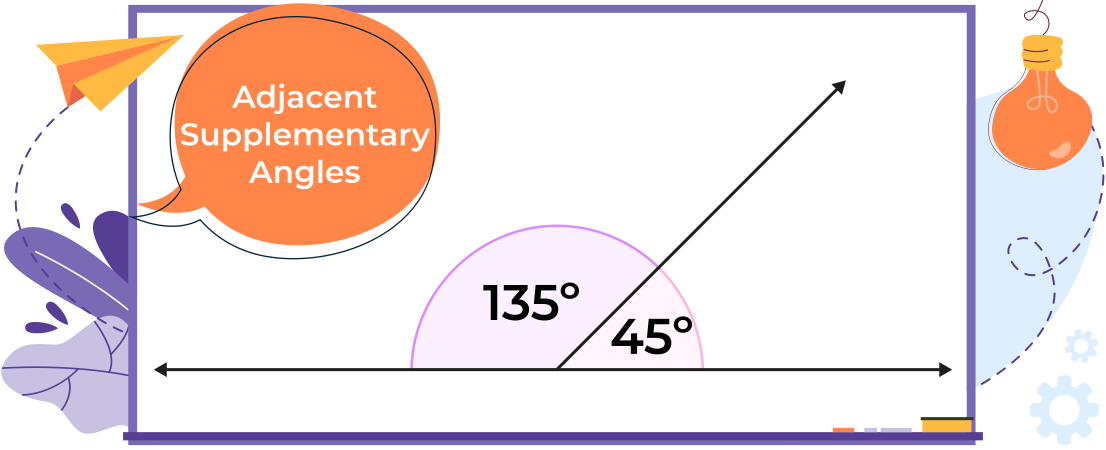

By observation, we can easily tell that adjacent supplementary angles form a straight line.

Non-adjacent Supplementary Angles
If two angles are non-adjacent but have a total angle measure of
, then they are called non-adjacent supplementary angles.
Let’s look at the examples to see how it is different from adjacent supplementary angles.
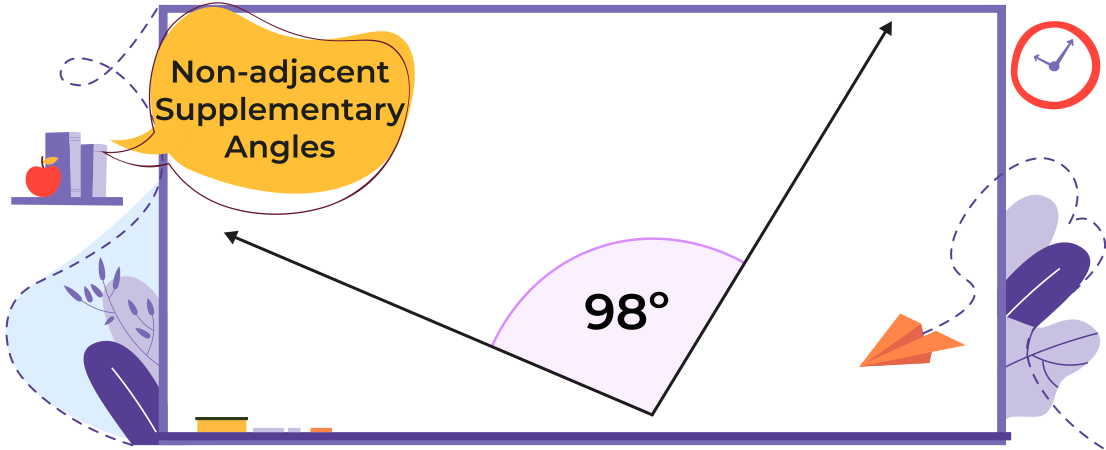
In the given figure, if two angles do not share the same side or vertex, they can still be supplementary angles as long as the sum of the two angles is
Did you know that…
That the word “supplementary” is from two Latin words, “supplere” and “plere.” Supplere means “supply” while “plere” means “fill.” So we can simply say that “supplementary” means “something to supply to fill a thing.”
And so are the supplements of angles!
How to find the supplement of an angle?
There may be cases or problems that you will encore that will require you to find the other pair of supplementary angles. Are you getting curious about how we can solve these types of problems?
Well, here's an easy way of solving and finding the supplement of a certain angle!
By definition, we already know that supplementary angles always add up to 180. Hence, if one is already given, we can easily find the supplement of the angle by simply subtracting the angle’s measure from .
Say, for example, we have an angle whose measure is and we are asked to find the supplement of this angle. To do this, we will subtract from . Thus, we will have .
Therefore, the supplement of is .
It’s simple, right? It is basically subtracting the given angle from !
Now, let’s try another example. I measures and is supplementary to , what is the angle measure of ?
To solve this problem, we will always go back to the definition of supplementary angles. Since the given angle measures , we will subtract it from . Hence, .
Therefore, by subtraction, we are able to know that the supplement of is .
See, finding the supplement of a certain is as easy. You just always have to remember the total angle measure of supplementary angles.

Solving problems involving supplementary angles
Now that you know the basics of finding the supplement of specific angles, let’s try to apply it to solve more problems.
Problem 1
Suppose the line formed by two angles is a straight line, as shown in the figure. What should be the angle measure of x?

The problem states that two angles formed a straight line. Hence, we can already conclude that the sum of the two angles is . Thus, we need to find the supplement of the given angle.
To find the value of x in the given problem, need to create a mathematical sentence to show that their sum is . Hence, we can write it as .
To find the value of x, we can rewrite the equation as Then, by subtraction, we will have Therefore, the measure of angle x is
Now, let’s try another problem without the aid of illustrations.
Problem 2
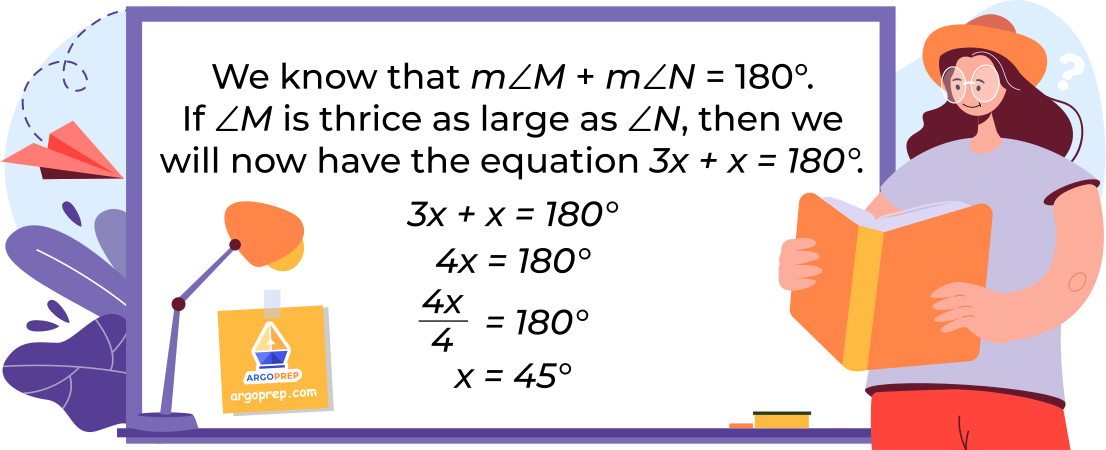
If and are supplementary angles, and is thrice as large as , what are the angle measures of and ?
This may look confusing and difficult to answer, but it’s actually not. To solve this type of problem, we are going to use our knowledge in algebra.
We already know that If and are supplementary angles, which means that if we add them together, the result will be . Hence, we can write it as
Then, we have a condition wherein is thrice as large as . From this statement, we already know that is larger than . Now, we are going to represent the two angles. Thus, we can say that and .
By substituting the and to the equation , we will now have the equation Working out the equation, this will result to
Hence, . By substitution, .
Thus, we now know that and .
Since and , we can say that and , by substitution.
Therefore, the angle measure of is and the angle measure of is .
Supplementary angles VS Complementary angles
Supplementary and complementary angles are pairs of angles that add up to and , respectively. Let’s take a closer look at their differences.
| Supplementary Angles | Complementary Angles |
|---|---|
| The sum of the two angles is
. | The sum of the two angles is
. |
| The supplement of an angle can be solved using the formula
. | The complement of an angle can be solved using the formula
. |
| Supplementary angles form a straight angle when combined together. | Complementary angles form a right angle when combined together. |
| Supplementary starts with letter “S” and Straight also starts with letter “S”. Thus, this can be a way to easily remember that a pair of supplementary angles forms a straight line. | Complementary starts with letter “C” and “Corner” also starts with letter “C.” Thus, complementary angles can be remembered as Corner (right) angles when they are combined together. |
Take a quiz
Question 1Review: Supplementary angles
What key idea does the article explain about “Supplementary angles”?
Supplementary angles are angles that when added together, their sum is. Since the sum of their angle measure is, supplementary angles always form a straight line. Using the mathematical sentences, we can say that two angles are supplementary ifLet’s look at one example of supplementary angles.In the figure, we can see two angles – one measuring and the other angle with measure . If we get the sum of two angles, we will have Since the sum is exactly , we can
Question 2Review: Types of Supplementary Angles
What key idea does the article explain about “Types of Supplementary Angles”?
Like complementary angles, supplementary angles can be adjacent or non-adjacent. Let’s discuss how these two types are different from each other.
Question 3Review: Adjacent Supplementary Angles
What key idea does the article explain about “Adjacent Supplementary Angles”?
If two angles share a common vertex and a common side and have a total of angle measure when combined, then they are said to be adjacent supplementary angles.Let’s take a look at these illustrations.By observation, we can easily tell that adjacent supplementary angles form a straight line.
Question 4Review: Non-adjacent Supplementary Angles
What key idea does the article explain about “Non-adjacent Supplementary Angles”?
If two angles are non-adjacent but have a total angle measure of, then they are called non-adjacent supplementary angles.Let’s look at the examples to see how it is different from adjacent supplementary angles.In the given figure, if two angles do not share the same side or vertex, they can still be supplementary angles as long as the sum of the two angles is Did you know that… That the word “supplementary” is from two Latin words, “supplere” and “plere.” Supplere means “supply” while “plere” means “fill.” So we can simply say that “supplementary” means “something to