Practicing
math with 4th grade learning games will help your child become a master in their subject.
Studying should not stop at worksheets and written equations; why not look into creative, engaging, fun ways to learn?
A variety of learning methods is proven to be beneficial. As such, these are sure to boost your child’s abilities in math.
| 4th grade Learning Games to Try at Home |
| Place value up to 1 million |
| Multiplication and division word problems involving pictures, equations, and rounding |
| Factor pairs from 1-100 (for example factors of 20 are 1, 2, 4, 5, 10, and 20) and recognize that all numbers are multiplies of their factor pairs |
| Know the difference between prime and composite numbers (for example, 5 is prime because it has only 2 factors: 1, and 2. 10 is a composite number because its factors are 1, 2, 5, and 10) |
| The meanings of digit place value in whole numbers |
| Fractions with like denominators, how to add them, and how to subtract them |
| And more |
Subject Matter to Include in Your Games
It is important to know what
math your child is learning about before you create a 4
th grade learning game to play.
This way, you will know what topics to include. Throughout the
4th grade, your child will learn about:
- Place value up to 1 million
- Multiplication and division word problems involving pictures, equations, and rounding
- Factor pairs from 1-100 (for example factors of 20 are 1, 2, 4, 5, 10, and 20) and recognize that all numbers are multiplies of their factor pairs
- Know the difference between prime and composite numbers (for example, 5 is prime because it has only 2 factors: 1, and 2. 10 is a composite number because its factors are 1, 2, 5, and 10)
- The meanings of digit place value in whole numbers
- Fractions with like denominators, how to add them, and how to subtract them
- And more
[workbook=12145][workbook=12148][workbook=11874]...
To further understand the concepts your 4
th grader will cover, check out Common Core standards for
your state.
4th Grade Learning Game Ideas
Flashcards
One of the most basic tools to implement in math learning games for 4
th graders is a set of flashcards. You can use these the traditional way for a quizzing game.
Or, you can shake it up! Try creating a
matching game with them.
Or, you can make your own set with your child and quiz them as they go. Try incorporating a point system.
If your child has a goal to win the game, rather than just trying to study, they will be more enthusiastic. (Bonus enthusiasm if there are prizes involved!)
[subscribe=20543]
Boardgames
Math learning games for 4
th graders are as fun as you make them out to be. Try creating a board game similar to Sorry! or Candy Land.
You can use a game board and pawns that you already have. Alternatively, you and your child can work together to make a custom set.
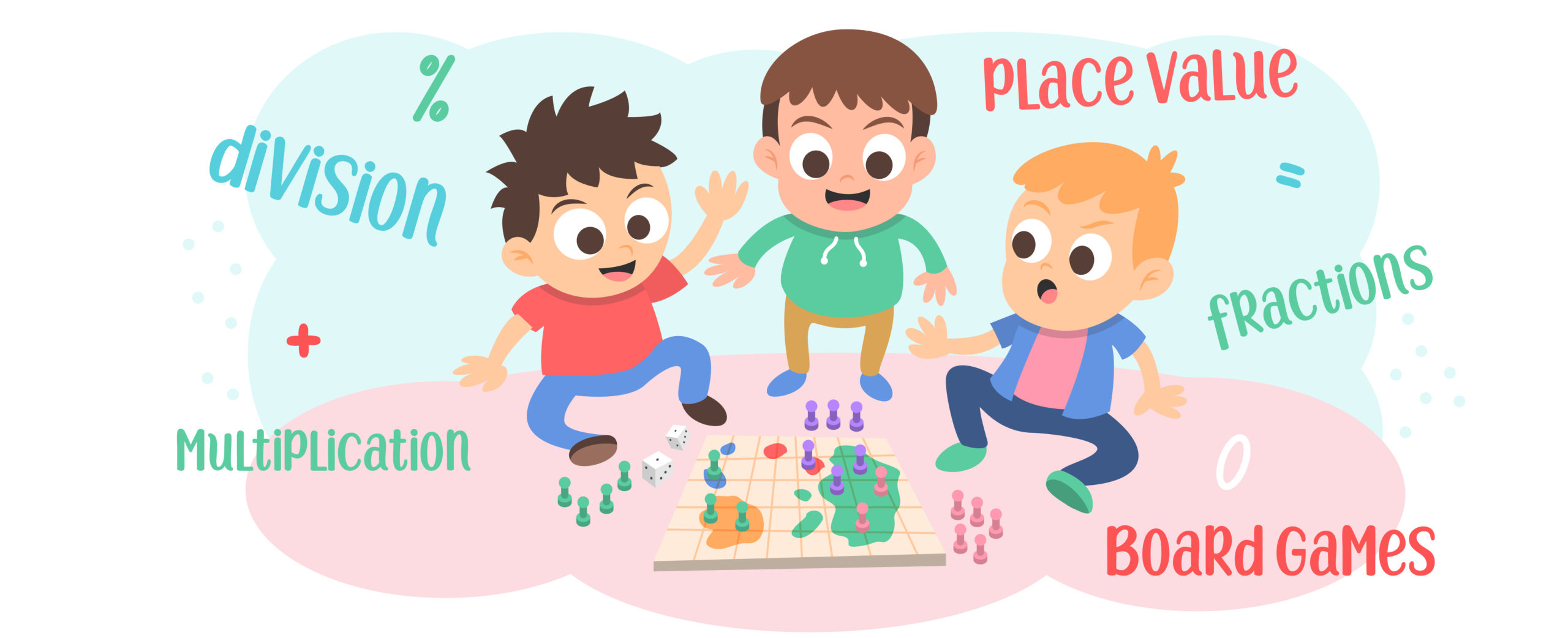
You can incorporate math in any way you see fit.
For example, roll dice to see how many spaces to move forward. Write an equation in every space. (If you are using a board for a premade game and don’t want to write on it, have problems ready on the side.)
I have helped my children make boardgames in the past and they loved it! For older kids, give them full control when it comes to set up, rules, etc.
Have your child solve the equation when their pawn lands on that space. Or, for another method of gameplay, have a set of problems prepared alongside the board.
You can use flashcards or write a list. Have your child solve the problem before their turn. The answer to the equation is how many spaces they can move.
Math learning games for 4
th graders don’t need to be complicated or structured.
You can make up any rules you like. You can use a board that is as plain and simple or as complex and colorful as you choose.
Matching Game
Create cards with equations and corresponding cards with their solutions. Lay them out in front of your child and have them pair the cards up.
For a more intensive 4
th grade learning game, make it a memory matching challenge. Flip the cards so that the blank sides face up.
Follow the usual memory game format. Have your child flip any two cards per turn. If they flip an equation card and its corresponding solution card, they may leave the cards face up.
However, if they flip two cards and they do not correctly correspond, they must flip the cards back to face down position.
This way, they will exercise their math skills in two ways. They will practice both solving the equation and memorizing the solutions.
If building a game from scratch is not possible for you, or if you simply want to add more games to the mix, try online games.
There are many
programs online that include math learning games for 4
th graders.
Tips to Keep in Mind
During the early stages of
any math concept, avoid timers or time limits for your child to solve equations. This may lead to your child feeling pressured.
As such, rather than really trying to solve the problems, they may instead resort to throwing out guesses. Let them take their time to find the right answer in these beginning stages.
However, once your child is more familiar with a subject, a timer can help to quicken their recognition.
In addition to avoiding timers, try to avoid negative points in your math games. This is especially important when your child is just beginning with a concept.
While you shouldn’t reward wrong answers, don’t subtract points for them either. This will only frustrate and discourage your child and inhibit their learning.
Finally, consider
ArgoPrep’s learning program. It will help prepare your child with quality activities and engaging lessons.