
Inequalities
Early in your mathematical learning, you learned about equations like 3 + 2 = 5. The equal symbol “=” is indicating that everything to the left of the symbol is the same value as everything to the right of the symbol. When you are solving equations you are finding what should be on the other side of the equal side to make it true. There are many other symbols that compare values. Let's explore them out!
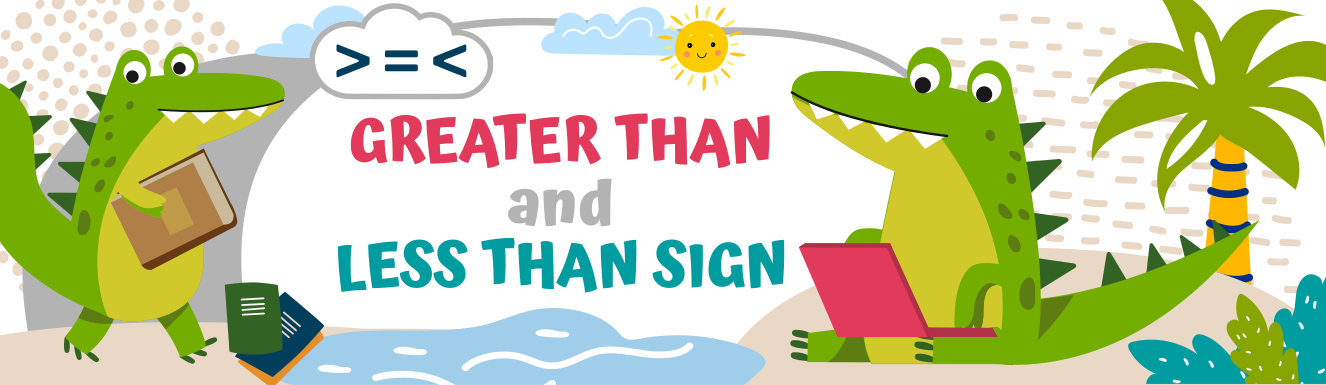
Greater Than and Less Than
One of the symbols is the greater than symbol as shown below ">"
This symbol says that the value to the left of the symbol is larger than the value to the right of the symbol.

A similar symbol is the less than symbol "<"
This symbol says that the value to the left of the symbol is smaller than the value to the right of the symbol.


Using The Symbols
The greater than and less than symbols are also known as inequality symbols. Inequality means not equal. These symbols are great when comparing two values that may not be equal. This can be any number of things, books read, age, height, the number of pets you have. Let’s look at some examples.

Mary is older than Joey.
We do not know how old either mary or Joey is, but we know that Mary is older. This means that her age is bigger than Joey’s age. We can show this with a greater than symbol.
Mary’s age > Joey’s age
We can also flip this around. We know that Joey’s age is smaller, or less than, Mary’s age. So we can also use the less than symbol.
Joey’s age < Mary’s age
Understanding the Symbols
These symbols look very similar. How do you know which one to use? There are a few different ways to help understand the symbols better and know which on to use. One way is to look at the symbol from left to right. Just like you read from left to right, symbols and equations can be read left to right. Let’s take a closer look at the greater than symbol.

Looking at the symbols left side, you see the bigger part first. Bigger means greater. This is the symbol for greater than.

Notice that the smaller portion is what you see first. Smaller means less. This symbol is the less than symbol. Another trick for the less than symbol is that the symbol “ < “ looks similar to the letter “L”. Less than also starts with the letter “L”. How neat!

Another useful method is known as the alligator method. This method can seem more for the younger student, but it is one of the more helpful methods to know how to draw in the symbol you need. Imagine the symbol as a hungry alligator. It always wants to eat the bigger portion.

If you have two numbers to compare, 12 and 45 you have the alligator eat the bigger number. This is method is helpful when the order of numbers starts to be flipped around. Ask yourself which number is larger and have the opening towards that number
12 ? 45 or 45 ? 12
12 < 45 or 45 > 12
Or Equal To
What if the values can be equal to? This is where the “less than or equal to” symbol, " ≤ ", and “greater than or equal to” symbol, " ≥ ", come into play.

Less Than Or Equal To

Imagine a pitcher of juice. The pitcher can hold 12 cups of juice. How much juice is in the pitcher? If it is filled up to the top it has 12 cups in it. As people drink the juice the amount goes down. We can say that the pitcher has no more than 12 cups of juice. This can be written using the symbols:
juice ≤ 12 cups
If more than 12 cups are poured into the pitcher it overflows so the amount can’t be more than 12. The pitcher as no more than 12 cups of juice.
The phrases “no more than” and “no more than” are often used with the less than or equal to symbol.
Can you think of other situations that the less than or equal to symbol can be used?
Greater Than Or Equal To

If you have ever been on a roller coaster ride or been to an amusement park you may have seen a sign that said “You must be at least 4 feet tall to ride this ride”. Using the symbols it would look like this:
Height ≥ 4 ft
If you are 4 feet tall you can ride the ride and if you are taller you may ride. If you are shorter, or less than 4 feet tall you are not allowed to ride. Maybe next year.
The phrase “at least” is commonly used when working with greater than or equal to.
What About Zero?
As you learn about inequality symbols you often use one at a time. However, you can use more than one symbol to indicate a range. We can use the previous examples to show this. Remember that pitcher that hols 12 cups of juice? We know that 12 cups is the greatest amount it can hold, but what is the least amount? It can have no juice in the pitcher. This means that the amount of juice is greater than or equal to zero as well as less than or equal to 12 cups!
0 cups ≤ amount of juice ≤ 12 cups
Combining Symbols

There are many different situations in which a range of values would be acceptable. This would mean that there would be a need to use two symbols.
Jeff has $20 in his pocket and wants to buy a present for his sister. He needs to make sure that he has $2 left over to pay back his friend. How much money can he spend on the gift?
When working with inequality symbols and problems, it may be helpful to think about the biggest value and the smallest value. He has $20, but still owe his friend $2. That means he only has $18 to really spend. That is the largest value. Jeff can spend $18 or less than $18.
Amount spent ≤ $18
What is the smallest amount that he can spend? Jeff doesn’t need to spend any money at all! He can make a gift and spend no money at all. So he can spend $0 or more than $0.
Amount spent ≥ $0
Now that we have two statements how do we combine them? We will rewrite the first statement we made. Next look at the opening for the zero money spent. It is opened towards the words. When we put the zero on the left side we want to make sure the symbol is still opening towards the words “amount spent”
$0 ≤ Amount spent ≤ $18
Graphs
You can also visualize a numberline to help organize the symbols, it fact, number lines are used to graph inequalities and have a visual representation of the symbols. Let’s use the previous examples to show a visualization and graphs of the situations.
Height ≥ 4 ft
When graphing you want to start on a numberline. With this example we want to start at the 4. A circle is placed at the four indicating that this is where the values that make this statement true are. Since 4 also makes it true we fill in the circle to make is solid.

Next we want to shade in the direction of the true answers. Greater than means bigger, so we want to shade the numbers larger than 4.
You can always test out numbers to find out where to shade as well. Does 3 or 5 make the statement true?
3 ≥4 5 ≥ 4
False True
Make sure that the 5 is shaded.

Now let’s look at an example that has two symbols. Remember that pitcher of juice?
0 cups ≤ amount of juice ≤ 12 cups
Since there are two values we want to start with those. Create a numberline. Put circles around the smallest value, zero, and the largest value, 12. Since the symbols are also equal to, we can fill in the circles.

Now we want to find the values that make this statement true. Look at the values to the left and right of both circles. Can the pitcher have a negative amount of juice? Nope. can the pitcher have 13 cups of juice? No, it will overflow. Can it have 2 cups or 10 cups? Yes. These are the values that are shaded in.

These examples both had equal to as part of their symbols. If the symbol is just greater than or less than, the circles are open. An open circle indicates that the number that is circled does not make the statement true.
x < 14

Not Equal To
The last symbol that we are going to discuss is not equal to, ≠ . just like the name says, the value on the left side of the symbol is not the same as the value on the right side of the symbol.

3 ≠ 4
This symbol is used to show when an answer is not correct, or the value can be anything other than one number.
2 + 3 ≠ 6 number of pets ≠ 4
Practice
Question 1Review: Inequalities
What key idea does the article explain about “Inequalities”?
Early in your mathematical learning, you learned about equations like 3 + 2 = 5. The equal symbol “=” is indicating that everything to the left of the symbol is the same value as everything to the right of the symbol. When you are solving equations you are finding what should be on the other side of the equal side to make it true. There are many other symbols that compare values. Let's explore them out!
Question 2Review: Greater Than and Less Than
What key idea does the article explain about “Greater Than and Less Than”?
One of the symbols is the greater than symbol as shown below ">"This symbol says that the value to the left of the symbol is larger than the value to the right of the symbol.A similar symbol is the less than symbol "<"This symbol says that the value to the left of the symbol is smaller than the value to the right of the symbol.
Question 3Review: Using The Symbols
What key idea does the article explain about “Using The Symbols”?
The greater than and less than symbols are also known as inequality symbols. Inequality means not equal. These symbols are great when comparing two values that may not be equal. This can be any number of things, books read, age, height, the number of pets you have. Let’s look at some examples.Mary is older than Joey. We do not know how old either mary or Joey is, but we know that Mary is older. This means that her age is bigger than Joey’s age. We can show this with a greater than symbol.Mary’s age > Joey’s ageWe can also flip this around. We know that Joey’s age is smaller, or less than, Mary
Question 4Review: Understanding the Symbols
What key idea does the article explain about “Understanding the Symbols”?
These symbols look very similar. How do you know which one to use? There are a few different ways to help understand the symbols better and know which on to use. One way is to look at the symbol from left to right. Just like you read from left to right, symbols and equations can be read left to right. Let’s take a closer look at the greater than symbol.Looking at the symbols left side, you see the bigger part first. Bigger means greater. This is the symbol for greater than.Notice that the smaller portion is what you see first. Smaller means less. This symbol is the less than symbol. Another tr
Algebra Examples
Question 5Review: Or Equal To
What key idea does the article explain about “Or Equal To”?
What if the values can be equal to? This is where the “less than or equal to” symbol, " ≤ ", and “greater than or equal to” symbol, " ≥ ", come into play.
Question 6Review: Less Than Or Equal To
What key idea does the article explain about “Less Than Or Equal To”?
Imagine a pitcher of juice. The pitcher can hold 12 cups of juice. How much juice is in the pitcher? If it is filled up to the top it has 12 cups in it. As people drink the juice the amount goes down. We can say that the pitcher has no more than 12 cups of juice. This can be written using the symbols:juice ≤ 12 cupsIf more than 12 cups are poured into the pitcher it overflows so the amount can’t be more than 12. The pitcher as no more than 12 cups of juice.The phrases “no more than” and “no more than” are often used with the less than or equal to symbol.Can you think of other situations that t
Question 7Review: Greater Than Or Equal To
What key idea does the article explain about “Greater Than Or Equal To”?
If you have ever been on a roller coaster ride or been to an amusement park you may have seen a sign that said “You must be at least 4 feet tall to ride this ride”. Using the symbols it would look like this:Height ≥ 4 ftIf you are 4 feet tall you can ride the ride and if you are taller you may ride. If you are shorter, or less than 4 feet tall you are not allowed to ride. Maybe next year.The phrase “at least” is commonly used when working with greater than or equal to.
Did you Know?
- The signs for greater than (>) and less than (<) were introduced in 1631 in “Artis Analyticae Praxis ad Aequationes Algebraicas Resolvendas” which was written by Thomas Harriot.
- There are also other symbols such as ~ (similar to), ≅ (congruent to), and ≈ (approximately equal to)
- You can use inequalities to graph on a coordinate plan and find multiple solutions in a two dimensional space!