
Maybe you’re reading this because you’ve just registered for the upcoming GRE, or you’ve just emerged from your first GRE practice test feeling rather shaken. Don’t worry, you’re at the right place! By the end of this post, you’d have a clearer idea of how to prepare for the test and improve your score.
We recommend five main ways to improve your GRE Verbal Reasoning Score.
1. Take practice tests criticallyBegin by taking one or two practice tests, making sure to time yourself. Form a general impression of how well you tackle each section. Did you find the Reading Comprehension (RC) the most time-consuming? Were you able to understand, say, 50% of the vocabulary options in the Sentence Equivalence (SE) questions? Did you find that your scores for the Text Completion (TC) questions were unexpectedly low?
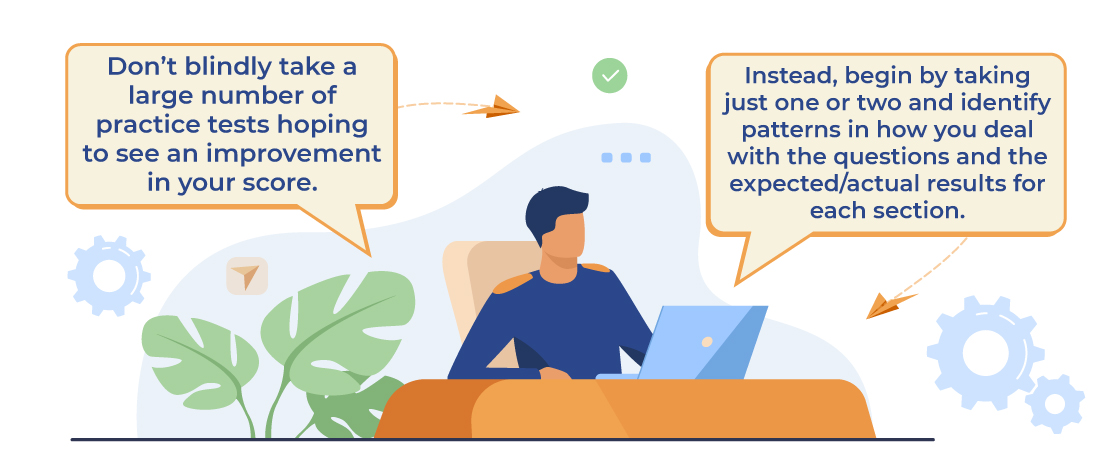
Don’t blindly take a large number of practice tests hoping to see an improvement in your score. Instead, begin by taking just one or two and identify patterns in how you deal with the questions and the expected/actual results for each section.
2. Identify your weak areasThe most straightforward way to find out your weakest area is to see which section consistently yields the lowest score for you. Find out why exactly you are not scoring well in that section. For instance, is it an unfamiliarity with the question types in the RC section? Or is it an utter lack of understanding in the face of difficult vocabulary in the SE questions?
Identify 3 weak areas that you want to begin working on. If you are unsure of what precisely to focus on, here are the most common weak areas amongst students:
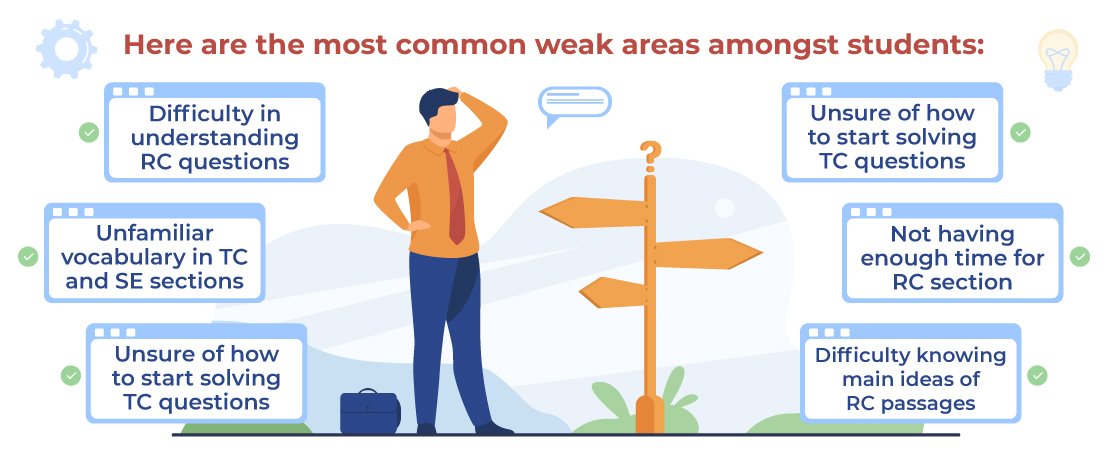
- Difficulty in understanding RC questions
- Unfamiliar vocabulary in TC and SE sections
- Unsure of how to start solving TC questions
- Unable to understand contorted SE questions
- Not having enough time for RC section
- Difficulty knowing main ideas of RC passages
Once you know which areas you need to work on, read up on their targeted strategies (click on the respective links above) and apply them to further practices and test preparation.
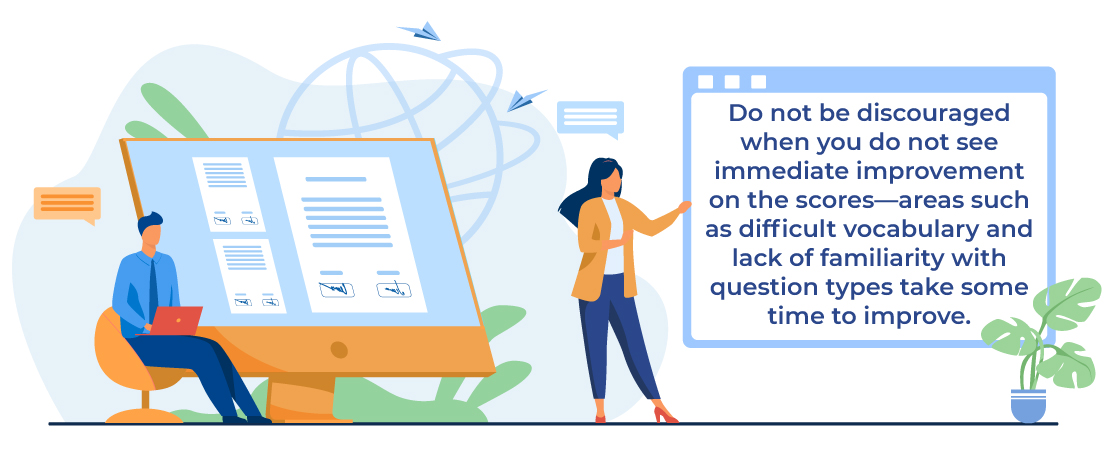
Keep track of how you are progressing with each area by assessing how you feel when taking the next timed practice test and keeping track of your scores. Do not be discouraged when you do not see immediate improvement on the scores—areas such as difficult vocabulary and lack of familiarity with question types take some time to improve.
4. Build your vocabulary bankI cannot emphasize this more strongly! Even if vocabulary is not one of the main areas you are immediately targeting, reinforcing the definitions of complex words and constantly familiarizing yourself with new words are bound to help you excel at the GRE.
For this reason, we strongly advise you to keep track of common GRE words and challenging vocabulary that you encounter in your practice tests and reading. Revise these words constantly so that they are integrated with your vocabulary bank. Do not leave vocabulary lists to the last minute!
5. Do not stop reading
Lastly, reading non-fiction, especially major publications and newspapers (I strongly advise the New Yorker) keeps your linguistic reflexes nimble and alert. This not only allows you to follow the arguments of RC passages more easily, but increases your ability to read quickly, critically and discerningly. You will find that those convoluted SE sentences become easier to understand!
Now that you have an idea of how to improve your GRE score, how about getting started with an online practice test? Remember to take it critically!