

The most common questions in mathematics about number 51 are: What are its factors? Is it divisible by 3? Is it a multiple of 9? Is it a prime or a composite number?
Those are all questions that we will answer next!
We will start recalling some definitions that we have widely discussed in our Prime Numbers article. If you still feel unfamiliar with these notions, we invite you to first read that article and come back here later.
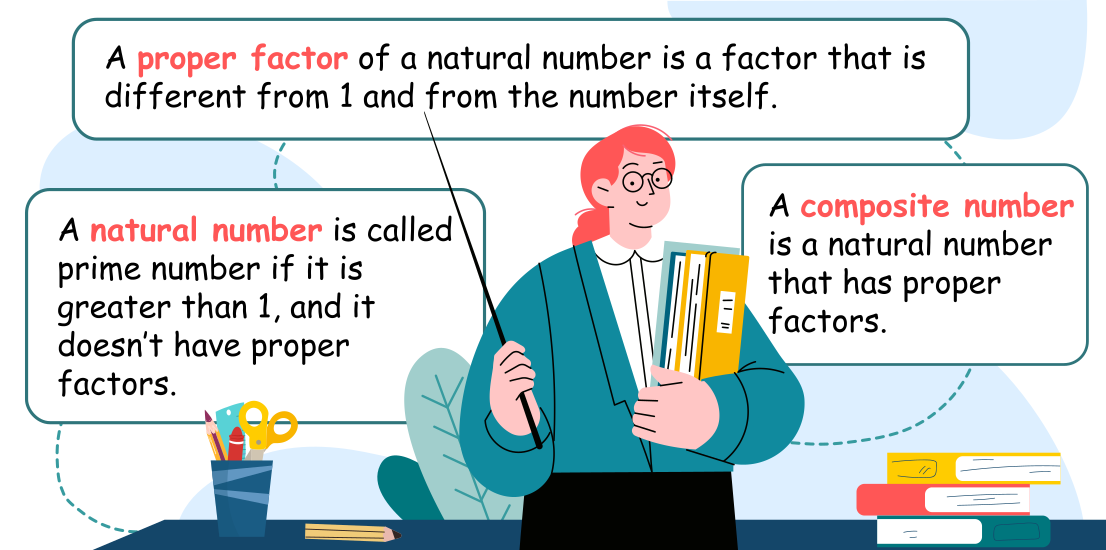
A factor of a natural number is a positive divisor of the number. A proper factor of a natural number is a factor that is different from 1 and from the number itself.

For example, ; thus, 1, 3, 5, and 15 are all factors of 15, but only 3 and 5 are proper factors of 15.
A natural number is called a prime number if it is greater than 1, and it doesn’t have proper factors. For example, the prime numbers closer to 51 are 47 and 53.
A composite number is a natural number that has proper factors. For example, 15 is a composite number because, as we just saw, it has proper factors. As we will see next, 51 is also a composite number.
Why is 51 not a prime number?
There are several ways of showing that 51 is not a prime number. For example, we can use the following property, that we discussed in our Prime Numbers article.
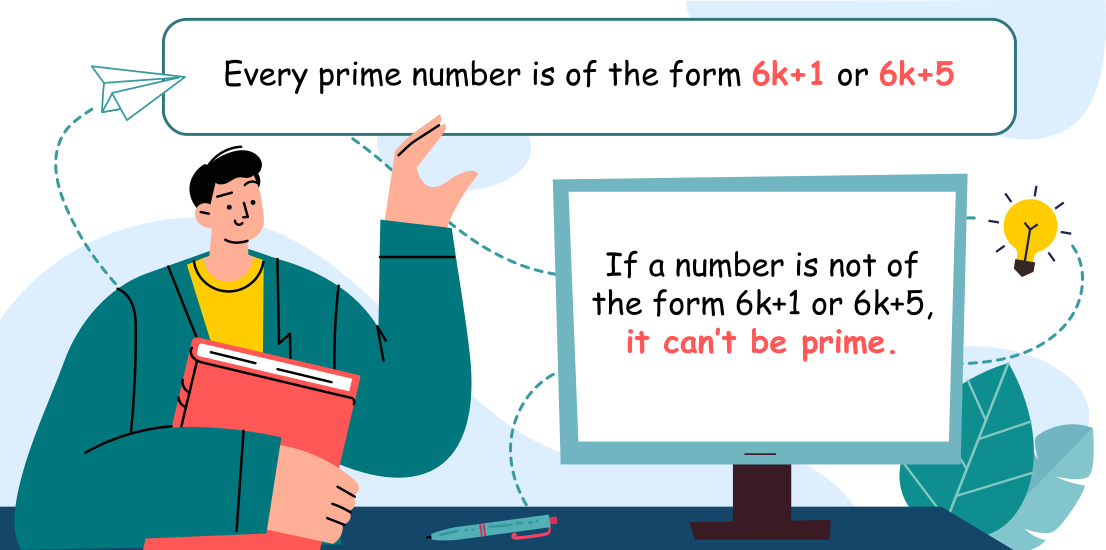
Every prime number is of the form 6k + 1 or 6k + 5: Therefore, if a number is not of the form 6k + 1 or 6k + 5, it can’t be prime. In other words, if the remainder when a number is divided by 6 is different from 1 or 5, then the number is not prime.
Notice that 51 = 6(8) + 3. Thus, the remainder of dividing 51 by 6 is 3, which is different from 1 and 5. Therefore, 51 is not prime, as the property above indicates.
This means that 51 is a composite number. Thus, 51 has proper factors. In order to find them, we will use the next property.
If 𝒏 is a composite number, then there is a prime number less than that divides 𝒏.
Notice that 51 < 64, thus . Therefore, the prime numbers less than are 2, 3, 5, and 7; and one of them must divide 51. It is not 2, because 51 is not an even number. Thus, we verify if 3 divides 51, and we get that it does: .
Therefore, 3 and 17 are proper factors of 51. Moreover, since 3 and 17 are both prime numbers, 51 doesn’t have more proper factors.
We can now answer all the questions from the introduction:
- Which are the factors of 51? They are 1, 3, 17, and 51 because .
- Is 51 divisible by 3? Yes, 51 divided by 3 is 17.
- Is 51 a multiple of 9? No, because 9 is not a factor of 51.
- Is 51 prime or composite? It is composite because it has proper factors.
Another way of understanding why 51 is not prime, is recalling that a prime number of objects cannot be arranged into a rectangular grid with more than one column and more than one row. As we see below, 51 stars can certainly be arranged into a rectangular grid with 17 columns and 3 rows. This means that 51 is not prime!

Occurrences of 51 among the prime numbers
Although 51 is not a prime number, it is closely related to prime numbers. For example, it is the product of exactly two prime numbers: 3 and 17. Also, until the year 2021, exactly 51 Mersenne primes are known; that is, prime numbers of the form 𝑝 = 2 𝑛 – 1, where n is an integer.
We list below some occurrences of 51 among the first few prime numbers. This way, you can have them at hand when deciding if some numbers related to 51 are primes.
| First few prime numbers where 51 occurs | 151, 251, 751, 1051 |
Example: Which of the numbers 251 and 351 is prime?
We first notice that 251 is in the table. Therefore, we know it is a prime number.
We also notice that 351 is not in the table. Thus, 351 should be a composite number. Moreover, one of the primes 2, 3, 5, 7, 11, 13, or 17 must be a factor of 351 (Why?). Indeed, 13 is a factor of 351 because . Therefore, 351 is a composite number!
Do you think 63 is a prime or not?