
Learning the fundamentals of math can be a challenge for many children, but it doesn't have to be! Use these tips to support at-home learning, and your child will be well on their way to becoming a math magician!
 Through utilizing activities that are interesting and fun, your child will be able to synthesize the concepts of these math fundamentals.
Once your child is invested in the activity, they can become a math magician too! It is the goal that after enough practice with hands-on experience, your child will be able to solve math problems mentally.
This outcome is only possible with consistent practice of the concepts using methods that appeal to your child.
Did you know ArgoPrep has an award-winning K-8 Math & ELA program designed to boost your child's math and reading scores? Try the first month 100% free!
[workbook=12166][workbook=16007][workbook=14031] ...
Through utilizing activities that are interesting and fun, your child will be able to synthesize the concepts of these math fundamentals.
Once your child is invested in the activity, they can become a math magician too! It is the goal that after enough practice with hands-on experience, your child will be able to solve math problems mentally.
This outcome is only possible with consistent practice of the concepts using methods that appeal to your child.
Did you know ArgoPrep has an award-winning K-8 Math & ELA program designed to boost your child's math and reading scores? Try the first month 100% free!
[workbook=12166][workbook=16007][workbook=14031] ...
 If your family enjoys board and card games, you may enjoy one of the many games available for purchase that deals with addition.
Here are a few of the more popular math games that you can purchase and start playing immediately: Sum Swamp Game, Sums in Space, and Clumsy Thief, are all easy to learn and fun to play! (Some ultra-competitive kids may find playing games frustrating if they can't easily win. Be mindful of your child's personality when bringing games home to play to ensure maximum fun and skill retention!)
[subscribe=20543]
If your family enjoys board and card games, you may enjoy one of the many games available for purchase that deals with addition.
Here are a few of the more popular math games that you can purchase and start playing immediately: Sum Swamp Game, Sums in Space, and Clumsy Thief, are all easy to learn and fun to play! (Some ultra-competitive kids may find playing games frustrating if they can't easily win. Be mindful of your child's personality when bringing games home to play to ensure maximum fun and skill retention!)
[subscribe=20543]
 Consider making it more fun by allowing your child to make the hands look like their favorite superhero or by painting the nails (or both!).
If your child enjoys more active learning, make subtraction a game. Set up 10 bowling pins and then have them figure out the remainder of pins after each roll. You can even set it up for them by writing "10- ___ =" to encourage the setting up of equations.
Another fun activity is whack-a-ball subtraction. For this activity, you will need 10 ping pong balls, a Kleenex box, and a toy hammer. Cut 10 holes in the bottom of the box that are just large enough to nestle the ping pong balls inside. Then using subtraction flashcards, have your child whack the balls that correspond with the number being subtracted. After they whack the balls out, their answer will remain!
Consider making it more fun by allowing your child to make the hands look like their favorite superhero or by painting the nails (or both!).
If your child enjoys more active learning, make subtraction a game. Set up 10 bowling pins and then have them figure out the remainder of pins after each roll. You can even set it up for them by writing "10- ___ =" to encourage the setting up of equations.
Another fun activity is whack-a-ball subtraction. For this activity, you will need 10 ping pong balls, a Kleenex box, and a toy hammer. Cut 10 holes in the bottom of the box that are just large enough to nestle the ping pong balls inside. Then using subtraction flashcards, have your child whack the balls that correspond with the number being subtracted. After they whack the balls out, their answer will remain!
 Another fun way to make multiplication more challenging (and delicious) is to prepare a recipe together. Try doubling or tripling the recipe for a bigger multiplication challenge. Find a recipe online for cookies, bread, or even slime and spend the afternoon creating something with your child. As they figure out the total amount for each ingredient they have successfully honed their multiplication skills!
Learn Math Fast
One of the most commonly hated subjects is math. It takes time and energy to understand math well enough to apply it to our day-to-day lives. Because of this, many children don't have the patience or energy to become competent in math. For children, learning math basics is the stepping stone to critical thinking skills and higher-level problem-solving. How can you engage your child in basic math when they hate it? Hint: The answer is not timed math drills (this method may cause math anxiety at an early age). The best way for children to refine and improve their skills is by creating activities that are fun and engaging. Consider what your child enjoys doing (sports, singing, coloring, etc.) and how they best learn.
Through utilizing activities that are interesting and fun, your child will be able to synthesize the concepts of these math fundamentals.
Once your child is invested in the activity, they can become a math magician too! It is the goal that after enough practice with hands-on experience, your child will be able to solve math problems mentally.
This outcome is only possible with consistent practice of the concepts using methods that appeal to your child.
Did you know ArgoPrep has an award-winning K-8 Math & ELA program designed to boost your child's math and reading scores? Try the first month 100% free!
[workbook=12166][workbook=16007][workbook=14031] ...
Math Magician Addition
What better way to become a math magician than to make addition a magic trick? Find a small cardboard box, cut the top out of it and a door in the front. In the hole at the top of the box stick two toilet paper rolls in and secure them with glue. Next, make flashcards with addition problems on them. When it's time to play, attach the card over the door using a clip. Using beads, pompoms, legos, or even chocolate chips, have your child insert the number of items that corresponds to the card in the correct toilet paper roll. They will do this for both numbers of the equation in the corresponding toilet paper roll. For example if the problem reads 4 + 7, they would insert 4 chocolate chips in the left slot and 7 chocolate chips into the right slot. When they are finished, ask them to solve the problem, right or wrong, it's okay, because once they open the door, they will see that they have the answer! There are many variations of this activity. Find the one that will work best for you!
If your family enjoys board and card games, you may enjoy one of the many games available for purchase that deals with addition.
Here are a few of the more popular math games that you can purchase and start playing immediately: Sum Swamp Game, Sums in Space, and Clumsy Thief, are all easy to learn and fun to play! (Some ultra-competitive kids may find playing games frustrating if they can't easily win. Be mindful of your child's personality when bringing games home to play to ensure maximum fun and skill retention!)
[subscribe=20543]
Math Magician Subtraction
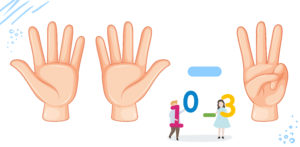
One of the oldest methods of subtraction is using our fingers to count up and down based on if we're adding or subtracting. Make it more fun for your child (and help them make that transition to mental solving) by tracing their hands on a piece of paper. Cut the tracings out and put small pieces of velcro on each of the fingers and the palm of the hand. Attach the hands to a piece of paper by gluing a strip along the back center of the hand. Make sure to not glue the fingers down! Using subtraction flashcards or even homework assignments, walk your child through sticking a finger down for each number being subtracted. For example, if the problem reads: 10-3, your child would stick three fingers down and count which fingers remain. Keep these hands as a resource that your child can use as they work through independent work with subtraction.
Consider making it more fun by allowing your child to make the hands look like their favorite superhero or by painting the nails (or both!).
If your child enjoys more active learning, make subtraction a game. Set up 10 bowling pins and then have them figure out the remainder of pins after each roll. You can even set it up for them by writing "10- ___ =" to encourage the setting up of equations.
Another fun activity is whack-a-ball subtraction. For this activity, you will need 10 ping pong balls, a Kleenex box, and a toy hammer. Cut 10 holes in the bottom of the box that are just large enough to nestle the ping pong balls inside. Then using subtraction flashcards, have your child whack the balls that correspond with the number being subtracted. After they whack the balls out, their answer will remain!
Math Magician Multiplication
With the use of a Mosaic tile sheet from your local hardware store, you can transform an ordinary home improvement item into a reusable multiplication table. Convert the tile by lining numbers on the y-axis and x-axis using a wet/dry erase marker. Then have your child fill in the remaining tiles with the multiplication answers. When complete, wash off, and it's ready for next time. Use this method whenever your child needs some extra attention on specific numbers for multiplying.
Another fun way to make multiplication more challenging (and delicious) is to prepare a recipe together. Try doubling or tripling the recipe for a bigger multiplication challenge. Find a recipe online for cookies, bread, or even slime and spend the afternoon creating something with your child. As they figure out the total amount for each ingredient they have successfully honed their multiplication skills!