
"I don't like that tone!", the mother says as her daughter slams her dirty dishes into the sink before letting out a huge sigh and stomping upstairs.
When we think of tone we often think about a phrase similar to the one used here: angry, aggressive, and most likely associated with a teenager.
The fact is, in writing, the tone is merely a literary device to help paint the picture of the plot. When tone, voice, and imagery are working together, readers are able to be transported from their own lives into the worlds of the characters on the pages.
Adding tone words to your writing will engage your reader and allow them to clearly understand your message without having to spell it out to them.
Creating these emotional connections through the use of tone words is the simplest and most effective way to convey emotion in your writing, whether you are crafting an email to a colleague or finishing up your future bestseller.
When students are working on developing their writing, tone, and voice - students can easily get confused.
Tone, words used to evoke feelings can often appear to be the same thing as voice. Voice is cadence, flow, and words used to drive the narrative and create the author's voice without explicitly saying, "her voice was chirpy and she was always happy".
Both of these literary devices help develop the quality of the writing, but they are very different.

Using Tone
When you are writing a text message to your friends in a group chat you most likely are going to use different words and phrases than if you were writing a paper for your AP English class (at least, we hope it's different!). This is the basic idea of tone: using different words and phrases to create an emotional response to your writing.
For more professional writing, you will use more professional words. Conversely, if you're writing a birthday message to your grandma, you'll use words that evoke the warmth and love you have for your grandma.
Categorizing Tone Words
Tone words are usually broken up into an overarching category. Either your writing is positive, negative, or neutral (but it can also be anything from positive-joyful to positive-respectful, so the spectrum is pretty vast).
Let's say that you recently got an invite to a school dance, you're excited to go and want to accept via text. Using tone, you are able to craft responses to evoke feelings for the reader:
Excited: "I can't believe you asked me to the dance! Of course, I would love to go with you! I've already told all of my friends!"
Accepting: "I got your invite to the dance, yes, I'd go with you."
Eager: "I would love to go to the dance with you! I am going to buy my dress today. Should you make reservations for dinner? Are there any friends you want to invite?"
Even though each of the reactions has accepted the invitation, through the use of different tones, each example evokes different feelings for the reader.
The same ideas can be applied to getting a negative response in writing, the dreaded one letter text, "K" can make anybody start sweating because for many they know that this means somebody is upset.
This can be considered tone too, by using just one letter, a writer is able to create an emotional response in the reader.
How to Use Tone Words Effectively
There are many ways that you can create tone in your writing. If you are wanting to create an impact with your writing, consider adding more engaging and thought-provoking prose to your writing.
Here are some things to consider when you are looking to add tone words to your writing.
First, it is crucial that you decide what the tone of your message is (professional, happy, serious, playful, etc.). Once you have identified the tone, seek tone words that will elevate your writing.
-
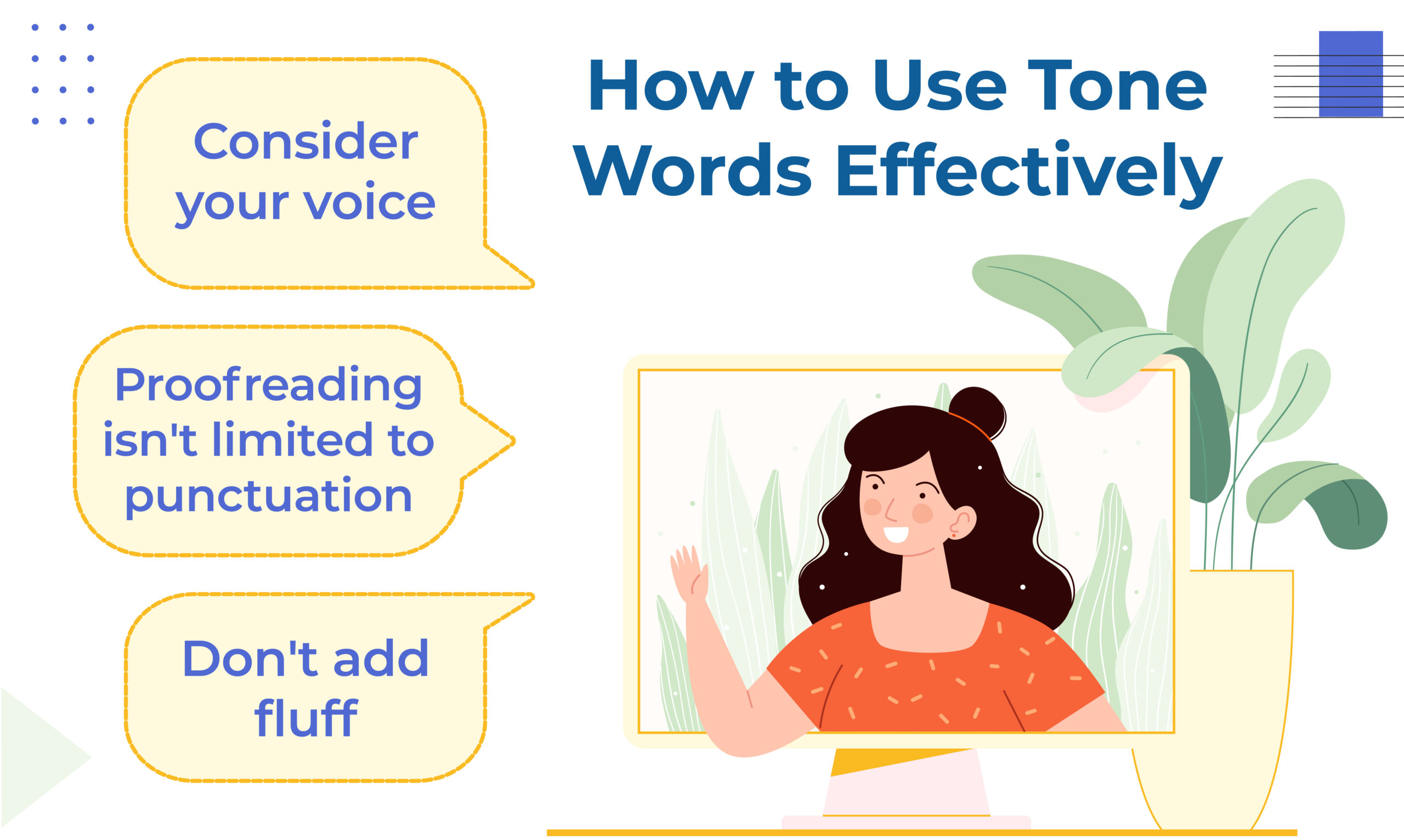
Consider your voice
This is especially important when you are writing something personal, like an email. People who know you, know how you sound when you talk. Using terms like "yeet!" or "boomer" will look especially out of place if you are a 40-year-old businesswoman addressing a large conference. When choosing tone words, choose words and phrases that most closely resemble the way that you speak. This will be more authentic to you and your reader will be more likely to believe that what you are saying is coming from your heart. -
Proofreading isn't limited to punctuation
(but that is certainly important too!): Have you ever read something written in all caps? When you read it, does it feel like the writer is yelling at you? The same is true for all of the punctuation. An ellipses (...) can be construed as waiting impatiently. "Misplaced Quotations" can give the impression of skepticism. Even a poorly placed exclamation point can send the wrong message. When writing something take time to read it aloud and pay attention to your tone to ensure that the correct message is being conveyed. -
Don't add fluff:
While tone words will elevate your writing, don't seek out words that are going to fluff your piece with no additional value. In writing, this can often be referred to as "snow", or unnecessary additions. Think about which words will add tone without detracting from the writing. Your proofreading process will be able to point out if you have been too wordy (you may even have to take a break to breathe if there are too many words).
Tips for Using Tone Words
There are numerous resources and lists available online to help kickstart your writing process. These lists are comprised of tone words that will help you clearly state your message without spelling it out for your reader. When using tone words, it is important to consider a few things to ensure that you are using tone words correctly in your writing.
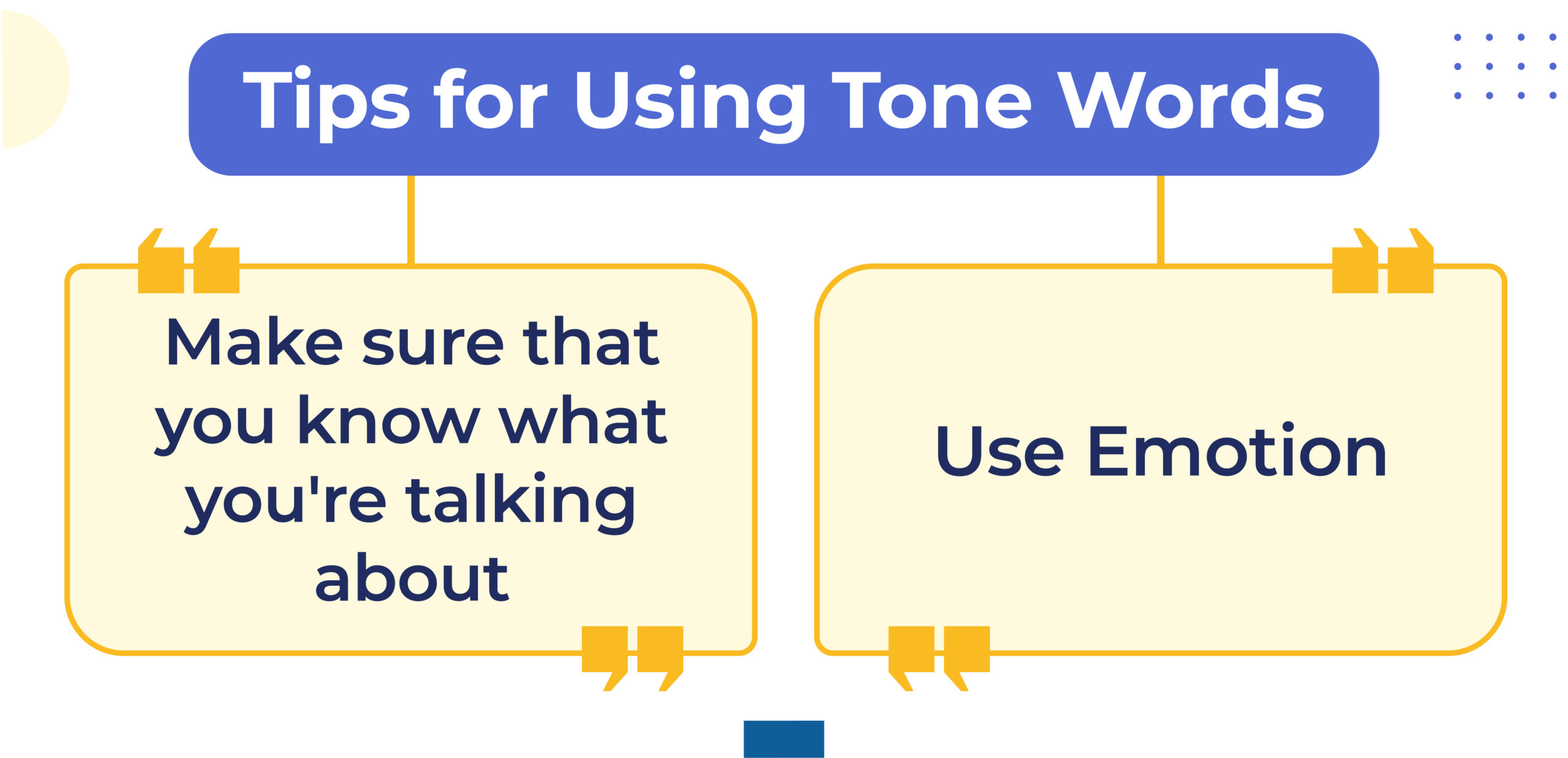
- Make sure that you know what you're talking about: When consulting outside resources such as a thesaurus, make sure that the words you are choosing are the correct words for the writing. Choosing the wrong words can create the wrong tone and derail high-quality writing in the process.
- Use Emotion: Always consider how your text will be received. Proofread it to ensure that you are using the correct tone and tone words for your message. If it is sending the wrong message, consider looking at a thesaurus to find the right words, or rephrase until you can deliver your message more clearly.
Sample List of Tone Words
As mentioned, there are thousands of lists of tone words to help get your writing process started. Returning to the idea that tone words typically fall under an umbrella of either positive, negative, or neutral, here are some tone words to get you started.
| Sample List of Tone Words | ||
|---|---|---|
| Postive | Negative | Neutral |
| Amiable | Critical | Ambiguous |
| Appreciative | Bitter | Conversational |
| Exuberant | Indignant | Pensive |
| Hopeful | Condescending | Solemn |
| Joyful | Insulting | Speculative |
| Vibrant | Testy | Casual |
| Loving | Irritated | Straightforward |
| Sympathetic | Facetious | Impartial |
| Brave | Brash | Objective |
| Hopeful | Outraged | |
Let ArgoPrep Help!
Whether you are struggling with tone words or looking for a little extra work with algebraic expressions, ArgoPrep is ready to help you soar at school. ArgoPrep has an exceptional team comprised of educators who are committed to providing students with the best educational support available.
Don't believe us? Check out our Award-Winning Online K-8 Math & ELA Program, available to students of all ages and abilities. ArgoPrep will give you the skills and confidence to understand and soar in your academic career!
Conclusion
One of the best ways to learn how to correctly use tone words in writing is through practice. By challenging yourself to craft different types of writing, you will be able to hone your skills, develop your tone and voice, and stretch some writing muscles that may have not been used in a while! If you love creative writing, try out an argumentative essay. Do you love writing screenplays? Challenge yourself to write a speech. Even if you are a seasoned fiction writer, try writing short biographies, press releases, or even a blog post!
These various drills will help you expand your vocabulary by having to seek out tone words that you might not normally use. Challenging yourself to think outside of your comfort zone will allow you to more clearly use tone words to evoke the correct emotion from your readers. Tone words will elevate your writing, which in turn, will allow your reader to more clearly understand your intended message.