
The multiples of 4 are the values that we get by multiplying 4 to any number. The number 4 is the first multiple of itself.
The multiples of 4 begin with 4 and continue infinitely.
We can find the multiples of 4 by skip counting by 4’s or by multiplying any number with 4.
Multiples of 4 are 4, 8, 12, 16, 20, 24, 28, 32, 36, 40, 44, 48, 52, 56, 60 ...
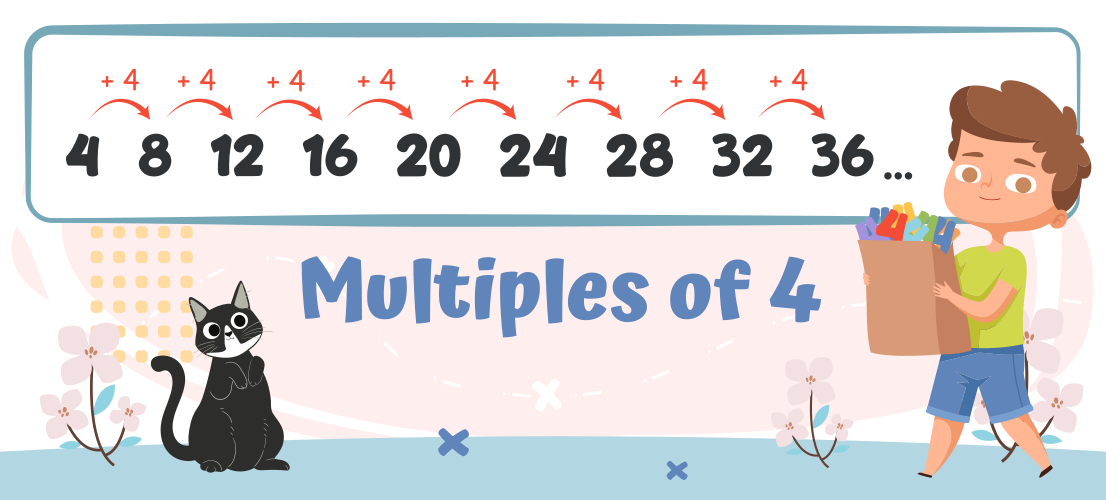
Finding the multiples of 4 by skip counting
- First multiple: 4
- Second multiple: 4 + 4 = 8
- Third multiple: 8 + 4 = 12
- Fourth multiple: 12 + 4 = 16
- Fifth multiple: 16 + 4 = 20
The skip counting helps to find the multiples of 4 only to a certain point as we need to work out the multiples from the beginning each time.
Find the multiples of 4 by multiplication
- First multiple:
- Second multiple:
- Third multiple:
- Fourth multiple:
- Fifth multiple:
Using the multiplication method, the value of any number of multiples can be found out.
The nth Multiple of 4
The nth multiple of 4 is given by 4n. That is, to find the multiple in the nth place of the multiples sequence, we multiply 4 to n.
Example:
Find the 50th multiple of 4.
The nth multiple of 4 is 4n.
The 50th multiple of 4 is

The Factors and Multiples of 4
- The factors of 4 are the values the give the product 4 when multiplied. ; . The factors of 4 are 1, 2, and 4.
- The factors of 4 are different from the multiples of 4 as the factors are the values that are multiplied to get 4 whereas the multiples of 4 are the values obtained by multiplying 4 to any given number.
- The factors of 4 are different from the multiples of 4 as the factors are the values that are multiplied to get 4 whereas the multiples of 4 are the values obtained by multiplying 4 to any given number.
- All numbers are both factors and multiples of itself.
Test of Divisibility for 4
The divisibility test for 4 helps to find if a number is divisible by 4.
If the last two digits of a number (the digits in the ten’s and one’s places) are divisible by 4, then the number is also divisible by 4.

Example:
Use the test of divisibility to find if the given number is divisible by 4.
516
Solution:
Consider the digits in the ten’s and the one’s place of the number. Here we have 16 as the last two digits.
Since 16 is a multiple of 4, the number 516 is also divisible by 4.
The Least Common Multiples

We already know that multiples are values obtained by multiplying various numbers to a given number.
A common multiple is a value that is common to two numbers.
A least common multiple is the first value that is common to two numbers.
Example:
Find the least common multiple of 4 and 6.
Solution:
The multiples of 4 are 4, 8, 12, 16, 20, 24, 28, 32
The multiples of 6 are 6, 12, 18, 24, 30, 36
Here 12 is the multiple that is common to both 4 and 6. We can see that 24 is also a common multiple, but the multiple that occurs the first is called the least common multiple of the given numbers.
Facts About 4
- The number 4 is the first number in the whole numbers to have prime factors other than 1 and itself. The factors of 4 are 1, 2 and 4. Here 2 is a prime factor.
- The number 4 is the first prime square number:
- The number 4 is the first composite even number.
- The value 0 is also a multiple of all the numbers as all the numbers multiplied by 0 gives 0.
Did You Know?
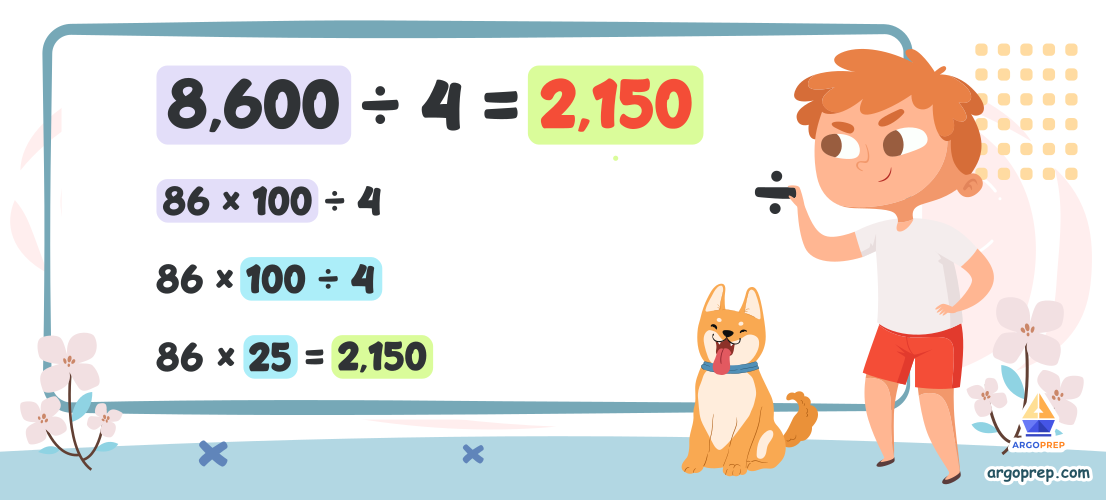
The number 4 can divide all the numbers that have 00 as their last two
digits like 100, 2400, 8600, 1000, 10000, etc.
This is because 4 has 100 as its multiple. Since 100 is a multiple of 4 and is divisible by 4. All the numbers that have 00 as their last two digits are also divisible by 4 and are a multiple for 4.
Check What I Know?
Question 1Recognize multiples of 4
What are the first five positive multiples of 4?
4, 8, 12, 16, 20.
They are found by multiplying 4 by 1, 2, 3, 4, and 5.
Question 2Continue the sequence
What comes after 20 in the sequence of positive multiples of 4?
24.
Add 4 to 20.
Question 3Check a multiple
Is 32 a multiple of 4?
Yes. 32 = 4 × 8.
A number is a multiple when it is the product of the original number and an integer.
Question 4Use division to verify
How can division confirm that 36 is a multiple of 4?
36 ÷ 4 = 9, with no remainder.
A whole-number quotient confirms the multiple.
Question 5Review: Finding the multiples of 4 by skip counting
What key idea does the article explain about “Finding the multiples of 4 by skip counting”?
First multiple: 4Second multiple: 4 + 4 = 8Third multiple: 8 + 4 = 12Fourth multiple: 12 + 4 = 16Fifth multiple: 16 + 4 = 20The skip counting helps to find the multiples of 4 only to a certain point as we need to work out the multiples from the beginning each time.
Question 6Review: Find the multiples of 4 by multiplication
What key idea does the article explain about “Find the multiples of 4 by multiplication”?
First multiple: Second multiple: Third multiple: Fourth multiple: Fifth multiple: Using the multiplication method, the value of any number of multiples can be found out.
Question 7Review: The nth Multiple of 4
What key idea does the article explain about “The nth Multiple of 4”?
The nth multiple of 4 is given by 4n. That is, to find the multiple in the nth place of the multiples sequence, we multiply 4 to n.Example:Find the 50th multiple of 4.The nth multiple of 4 is 4n.The 50th multiple of 4 is