
6/7 as a decimal is 0.857142
Want to practice?
[question item="1"] [question item="2"] [question item="3"] [question item="4"]Nick is working on converting the fraction $$\frac67$$ to a decimal. After getting three digits in the quotient, he is unsure if the answer is finite or a recurring decimal. Can you help him?
Solution

Recurring fractions are fractions that have one or more digits that occur repeatedly in a pattern. The type of decimal that we will arrive at in a long division can be of two types:
- a) Finite decimal or terminating decimal: The digits in the decimal do not repeat after any number of steps. They do not form a pattern. The division ends with a remainder of 0.
- b) Infinite decimal or non-terminating decimal: The digits in the decimal repeat after a certain number of steps. Once the decimal value begins to repeat, it can be concluded that the same values are going to follow. The division does not end in remainder 0 and is stopped when the remainder value is repeated.

Hence to find the correct type of decimal for a fraction, Nick should continue to divide until he gets are repeated digits pattern or 0.
Let us carry out the division as below:
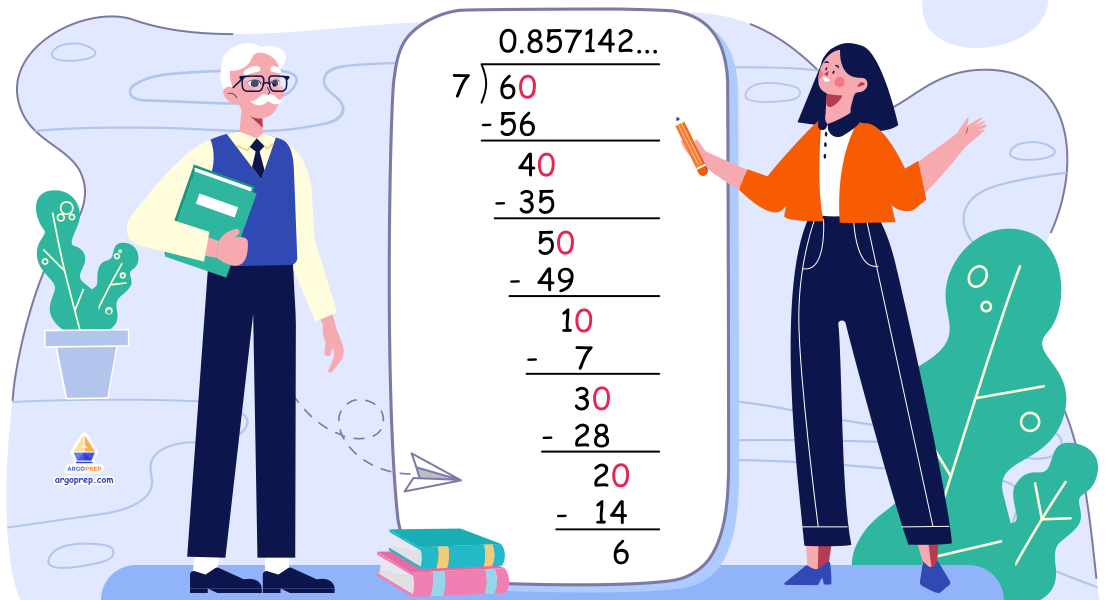
It can be observed that the remainder 6 is arrived at after 6 steps of division that is found in the first step. Hence all the digits following are recurring. So the answer to the fraction would be
$$\frac67=0.857142857142...=0.\overline{857142}$$
Remember
Here are some common terms you should be familiar with.
- In the fraction $$\frac67$$, the number 6 is the dividend (our numerator)
- The number 7 is our divisor (our denominator).
Find More Fractions to Decimals
We invite you to read other articles on decimal and fraction, on our blog, to find out how converting decimal to fraction.
Also, you can read about what is 2/11 as a decimal fraction.