
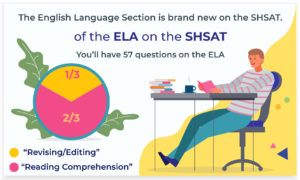
You’ve figured out by now that the English Language Section is brand new on the SHSAT. It’s been redesigned to help attract a new crop of students in NYC to take the exam and gain admission into specialized high schools. Remember, you’ll have 57 questions on the ELA—up to 20 total questions that are based on “Revising/Editing” and up to 40 questions that are in the “Reading Comprehension”
Think about that for a second: 2/3 of the ELA on the SHSAT centers around your ability to read! In a bit, we’ll cover specific strategies for Reading Comp, but right now, be courageous. If you can read this, you can solve 2/3 of the entire ELA block of the new SHSAT!
 The other 1/3 of the ELA is divided into two parts, Part A and Part B. Both parts have the same goal: Can you figure out errors in the way other people write?
Maybe you watched kids shows when you were little that played the game, “Which One of These Things Just Doesn’t Belong Here”. You’d see three pictures of pictures or animals who all were doing something similar (folks wearing the same hat, animals eating grass, etc.). But, there would always be one other picture included in the group that showed something different (someone not wearing a hat, or an animal sleeping, for example). Your job was to sing and dance and then pick the picture of the One that Just Doesn’t Belong in the group.
The Revising/Editing section is the grown-up version of Which One of These Things Just Doesn’t Belong Here. Your answer choices will be different—of course, this is for grown-up students—but they all are going to see if you can pick out bad writing and fix it, just like the younger version of yourself could pick out the napping cow from those eating the grass. The SHSAT writers have given you a game in Part A to figure out how well you can improve other people’s work.
The other 1/3 of the ELA is divided into two parts, Part A and Part B. Both parts have the same goal: Can you figure out errors in the way other people write?
Maybe you watched kids shows when you were little that played the game, “Which One of These Things Just Doesn’t Belong Here”. You’d see three pictures of pictures or animals who all were doing something similar (folks wearing the same hat, animals eating grass, etc.). But, there would always be one other picture included in the group that showed something different (someone not wearing a hat, or an animal sleeping, for example). Your job was to sing and dance and then pick the picture of the One that Just Doesn’t Belong in the group.
The Revising/Editing section is the grown-up version of Which One of These Things Just Doesn’t Belong Here. Your answer choices will be different—of course, this is for grown-up students—but they all are going to see if you can pick out bad writing and fix it, just like the younger version of yourself could pick out the napping cow from those eating the grass. The SHSAT writers have given you a game in Part A to figure out how well you can improve other people’s work.
 Are you taking the SHSAT exam? Be sure to check out our comprehensive online SHSAT test prep course!
Don't forget to read the official 2019-2020 SHSAT Handbook.
Up Next:
General Tips for ELA Part A
Time Management on the ELA Section
Are you taking the SHSAT exam? Be sure to check out our comprehensive online SHSAT test prep course!
Don't forget to read the official 2019-2020 SHSAT Handbook.
Up Next:
General Tips for ELA Part A
Time Management on the ELA Section
The other 1/3 of the ELA is divided into two parts, Part A and Part B. Both parts have the same goal: Can you figure out errors in the way other people write?
Maybe you watched kids shows when you were little that played the game, “Which One of These Things Just Doesn’t Belong Here”. You’d see three pictures of pictures or animals who all were doing something similar (folks wearing the same hat, animals eating grass, etc.). But, there would always be one other picture included in the group that showed something different (someone not wearing a hat, or an animal sleeping, for example). Your job was to sing and dance and then pick the picture of the One that Just Doesn’t Belong in the group.
The Revising/Editing section is the grown-up version of Which One of These Things Just Doesn’t Belong Here. Your answer choices will be different—of course, this is for grown-up students—but they all are going to see if you can pick out bad writing and fix it, just like the younger version of yourself could pick out the napping cow from those eating the grass. The SHSAT writers have given you a game in Part A to figure out how well you can improve other people’s work.
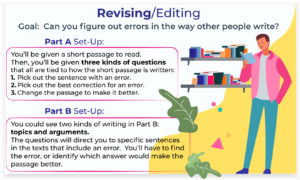
Part A Set-Up:
You don’t need a college degree to rock the ELA! There aren’t questions on Part A that are harder than the 7th-grade level. Since you’ve passed 7th, and are approaching this test in the way writers intended it, you won’t be surprised by the sorts of questions they are going to ask you on Part A. All questions in Part A start the same. You’ll be given a short passage to read (usually not more than three sentences. Then, you’ll be given three kinds of questions that all are tied to how the short passage is written. The three kinds are:- Pick out the sentence with an error.
- Pick out the best correction for an error.
- Change the passage to make it better.
Part B Set-Up:
Part B is a bit different. All of the questions in Part B will be based on only one passage—at the most, two. The sentences of the passage you’ll be given will be numbered, and sometimes the questions in Part B will refer to a specific sentence by number, to make things easier for you. The passage or passages will not be written well. Lots of things can go wrong in any passage. Some of them will be easy to pick out—if you’ve ever done group work in English and had to correct a classmate’s writing, you’ll know what I mean! But, some of the errors are trickier to pick out. It can be hard to figure out if a passage doesn’t have good transitions, introductions, or conclusions. You don’t have to rely on your own writing skills to get these right since the answer choices are going to give you enough clues to answer correctly. You could see two kinds of writing in Part B: topics and arguments. Topics are simply informative. Often, these will be bits of historical or scientific facts. The goal of the text is to explain the topic. Arguments are what you’d expect. These texts usually say something bold, and then back it up with some set of reasons or evidence. For both topics and arguments, the questions will direct you to specific sentences in the texts that include an error. You’ll have to find the error, or identify which answer would make the passage better.
Reading Comprehension Set-Up:
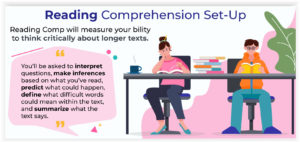
Part A and Part B are set up like puzzles. Reading Comp is, too, but not in the same way. For starters, there is an Invisible Player in the Reading Comp game: time management. The SHSAT writers will try to see if they can get you to spend way too much time on reading the passages instead of solving the problems given to you in the questions. ArgoPrep will help you get time to be on your team during the game, but you’ll first need to know how the section is set-up. 50 questions on any test is a lot of questions. Instead of one or two texts, like in Part B, you’ll get a crack at five (possibly six). You could see as many as 10 questions for each text. Whereas Part A and B are about fixing writing, Reading Comp is about figuring out what has been written. We’ll get to tools for conquering this section in a little while (hint: you’ll skip reading over and over!), but the Reading Comp will measure your ability to think critically about longer texts. You’ll be asked to interpret questions, make inferences based on what you’ve read, predict what could happen, define what difficult words could mean within the text, and summarize what the text says.
Are you taking the SHSAT exam? Be sure to check out our comprehensive online SHSAT test prep course!
Don't forget to read the official 2019-2020 SHSAT Handbook.
Up Next:
General Tips for ELA Part A
Time Management on the ELA Section