
From the dilemma of their, there, and they're to understanding the dreaded comma splice, the English language is flush with weird rules and subtle differences that can trip up even the most capable writers.
Any Google search can reveal results that will explain these rules, but sometimes those pages don't even seem like they're written in English! From terms like object, modifier, possessive, and more, resources can intimidate people who are seeking information to learn and improve.
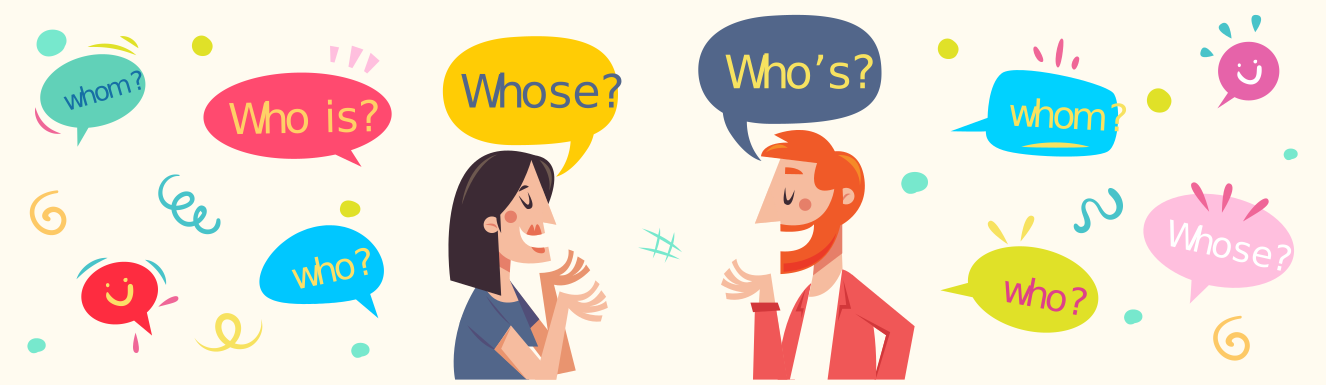
When it comes to the difference between who's and whose, many don't even realize they have different meanings, because they sound so familiar!

The ultimate learning platform that every parent needs in a K-8th grade household - to boost scores and confidence!
Monthly


Monthly
Everything is included. Anywhere!$12.99
/month$40.00
$12.99- 3 Days Money Back Guaranteed
- All Updates and Additions
When trying to decide whether to use who's or whose, writers can find themselves unsure of the correct spelling for their intended meaning.
In a world where the written word can be the most common form of communication, a simple slipup like using the wrong type of who's (or whose) can feel embarrassing.
Buckle your seatbelt, because we're about to walk through the (sometimes) complicated English rules and give you tips and tricks to spot the difference between whose and who's from a mile away.
What's the Big Difference?
Who's and whose phonetically are the same thing, which is why it is understandable that so many people get it confused when using it in writing.
The most significant difference between who's and whose is what each pronoun is modifying.
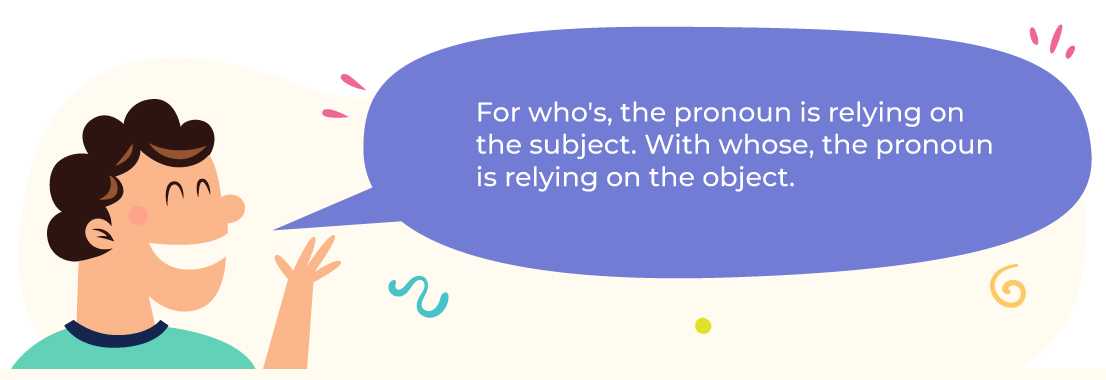
For who's, the pronoun is relying on the subject. With whose, the pronoun is relying on the object.
This is a lot of grammar jargon that a lot of people don't readily understand, so we went ahead and broke it down for you below.
Focusing on: Who's
Who's is a contraction. A contraction is a word that is simplified by taking out letters to shorten it. Common contractions include:
- Don't= Do not
- Haven't= Have not
- They're= They are
- Ain't= Am not
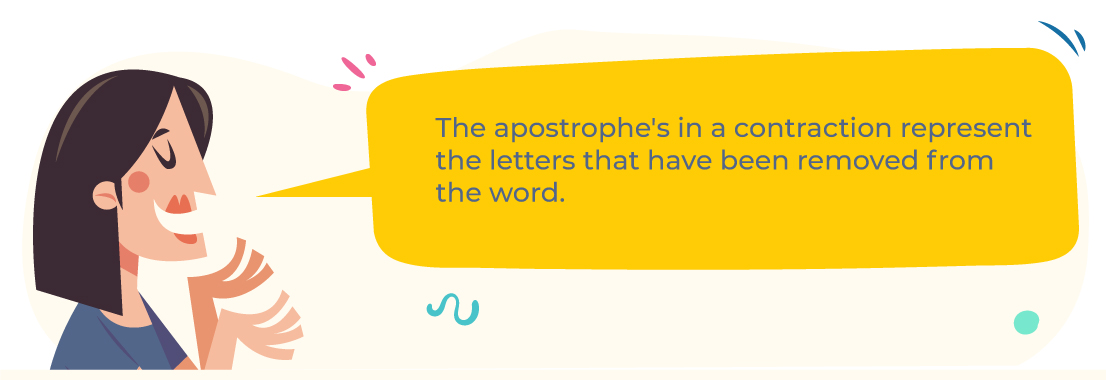
Okay, that last one isn't as clear, but you get the idea. The apostrophe's in a contraction represent the letters that have been removed from the word.
When looking at Who's, you can immediately see you have a contraction. Who's or who is/who has represents a pronoun in a sentence.
Remember: a pronoun is just a fancy way of saying I, me, you, them, they, she, etc. When you see who's in a sentence, you will know that they are talking about somebody, not something.
Who's is prioritizing the pronoun + subject and seeking ownership. Meaning, if you see a sentence that says, "Who's coming rafting with us this weekend?" the ownership belongs to whoever is going on the adventure.
So when you see "who's," you will immediately know that the sentence is talking about somebody.
Focusing on: Whose
Just like with who's, whose was created out of a relationship with another word. Before we dive into the rules of whose, we must first tackle its black sheep brother, whom.
Making Sense of Whom
Whom is an object pronoun that describes them, him, and her. An object pronoun's function is to belong to the verb or the preposition, not the subject.
That sounds really complicated, doesn't it? The subject (when you should use who) is the person, place, or thing that is doing something.
The object (when you should use whom) is the person, place, or thing that something is being done to.
Since whom is an object pronoun, we need to concern ourselves with the object, not the subject.
"With whom are you planning on delivering these fruits snacks to the office."
The object in this sentence is the fruit snacks. They are being delivered. Going back to the whom pronouns (him, her, them), the answer to these questions would be, "I am delivering the tasty treats with him" is a clear indication that whom is the correct use.
Another easy way to remember if you should use whom is to answer the question. "I am delivering the treats with him" makes more sense than, "I am delivering the treats with he."
Since we know that whom=him, her, them, we know that whom is correctly being used.
That's Great, but Tell Me About Whose
We already know that who's is a contraction including who.
Whose is directly related to whom.
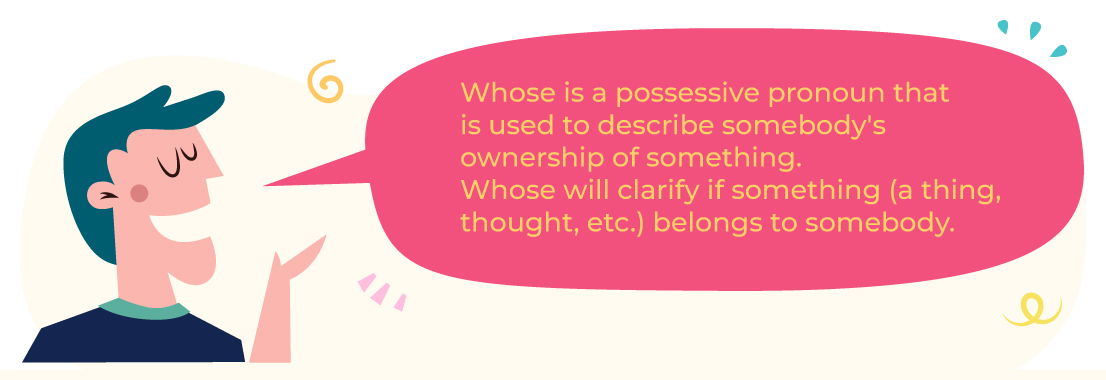
It is a possessive pronoun that is used to describe somebody's ownership of something.
Whose will clarify if something (a thing, thought, etc.) belongs to somebody. For example, Cindy asked whose baseball glove was missing, and the baseball glove is somebody's property.
Where who's is asking who is, a simple trick to use when deciding whose is asking who does (as in, who does this belong to).
While this is not a completely fool-proof cheat, it can help decide the correct usage for sentences.
Finally, who's usually is indicating somebody's ownership of something. For example, "Whose smelly gym shorts are these?" the gym shorts are the item in question, the owner is the one whose B.O. is undeniable.
One Final Cheat
For some, having all of the official English language rules doesn't make it any clearer about which form to use in writing.
That's why this simple trick will help you decide whether you need to use who's or whose when writing.
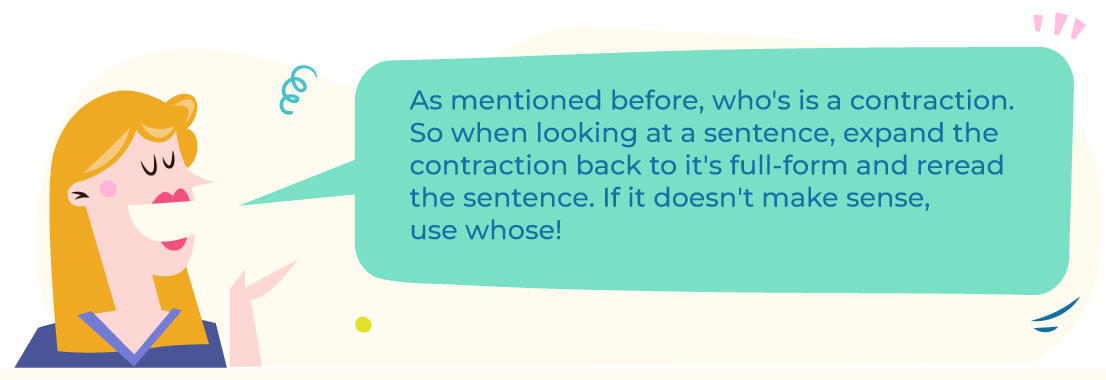
As mentioned before, who's is a contraction. So when looking at a sentence, expand the contraction back to it's full-form and reread the sentence. If it doesn't make sense, use whose!
For example, if your sentence is "Who's/Whose coming to the party on Friday night," reread the sentence as:
- Who is coming to the party on Friday night, or;
- Whose coming to the party on Friday night.
In this example, you are asking who will be attending a party, so "who is" or Who's would be the correct form.
Additionally, if you have a sentence that reads, "Sally, whose favorite color is purple, bought a new purple feather boa," reread the sentence as:
- Sally, who is favorite color is...or;
- Sally, whose favorite color is...
In this example, the form "who is" sounds completely wrong... because it is! Using whose would be the correct form here.
Examples of Who's
Here are some examples of when you would use who's:
- He's the DJ who's playing at the wedding.
- Do you know who's coming over tonight?
- Who's watching my Netflix right now?
Examples of Whose
Here are some examples of when you would use whose:
- Whose phone is ringing?
- She's the one whose dog ran away.
Try it For Yourself
Use this quiz to test your skills:
Question 1Review: What's the Big Difference?
What key idea does the article explain about “What's the Big Difference?”?
Who's and whose phonetically are the same thing, which is why it is understandable that so many people get it confused when using it in writing.The most significant difference between who's and whose is what each pronoun is modifying.For who's, the pronoun is relying on the subject. With whose, the pronoun is relying on the object. This is a lot of grammar jargon that a lot of people don't readily understand, so we went ahead and broke it down for you below.
Question 2Review: Focusing on: Who's
What key idea does the article explain about “Focusing on: Who's”?
Who's is a contraction. A contraction is a word that is simplified by taking out letters to shorten it. Common contractions include: Don't= Do not Haven't= Have not They're= They are Ain't= Am not Okay, that last one isn't as clear, but you get the idea. The apostrophe's in a contraction represent the letters that have been removed from the word. When looking at Who's, you can immediately see you have a contraction. Who's or who is/who has represents a pronoun in a sentence.Remember: a pronoun is just a fancy way of saying I, me, you, them, they, she, etc. When you see who's in a sentence, you
Question 3Review: Focusing on: Whose
What key idea does the article explain about “Focusing on: Whose”?
Just like with who's, whose was created out of a relationship with another word. Before we dive into the rules of whose, we must first tackle its black sheep brother, whom.
Question 4Review: Making Sense of Whom
What key idea does the article explain about “Making Sense of Whom”?
Whom is an object pronoun that describes them, him, and her. An object pronoun's function is to belong to the verb or the preposition, not the subject.That sounds really complicated, doesn't it? The subject (when you should use who) is the person, place, or thing that is doing something.The object (when you should use whom) is the person, place, or thing that something is being done to.Since whom is an object pronoun, we need to concern ourselves with the object, not the subject."With whom are you planning on delivering these fruits snacks to the office."The object in this sentence is the frui
Question 5Review: That's Great, but Tell Me About Whose
What key idea does the article explain about “That's Great, but Tell Me About Whose”?
We already know that who's is a contraction including who. Whose is directly related to whom.It is a possessive pronoun that is used to describe somebody's ownership of something.Whose will clarify if something (a thing, thought, etc.) belongs to somebody. For example, Cindy asked whose baseball glove was missing, and the baseball glove is somebody's property. Where who's is asking who is, a simple trick to use when deciding whose is asking who does (as in, who does this belong to).While this is not a completely fool-proof cheat, it can help decide the correct usage for sentences.Finally, who'
For more examples and practice, just like this, ArgoPrep has created a library of resources to help you become a grammar ninja. Whether you are trying to ace a high-stakes assessment or improve in your classes, ArgoPrep's comprehensive library is complete with workbooks, additional resources, video explanations, and online tutoring.

ArgoPrep's team is comprised of passionate educators who are invested in student success through high-quality resources and instruction.
The ultimate learning platform that every parent needs in a K-8th grade household - to boost scores and confidence!
Monthly
Monthly
Everything is included. Anywhere!$12.99
/month$40.00
$12.99- 3 Days Money Back Guaranteed
- All Updates and Additions
Who's the Grammar Ninja Now?
You might not be looking to become the next grammar ninja, but at least you will be confident enough to write that email to your boss (or tutor your kids).
The difference between who's and whose is vast, with wildly different meanings; however, when sounding them out, it's easy to get wrapped up into thinking they are interchangeable.
Now that you have gone through a crash course, you can confidently use the form without fear of stumbling. But, if you need a refresher, always remember to test out the "Who is" trick in any sentence you're unsure about.
For more tips and tricks like this, check out ArgoPrep's newest online comprehensive K-8 program.
Don't let the tricks of the English language confuse you anymore. ArgoPrep is written by teachers who know how to reach students. Their expertise will help any student understand complex topics (like the right time to use a semicolon, am I right?).
If there is ever a moment that you are struggling to understand a concept, ArgoPrep is ready with online video explanations and optional one-on-one tutoring, making it the best option for supplemental instruction!
Who's ready to use their new grammar skills in the wild?