
At a popular company, a job advertisement for a receptionist was placed on an online job board website. Forty-two applicants applied for this position. The human resources department runs the applications through a computerized process that sorts them into groups.
These groups are above average, average, and below average. The human resources department will then discard the below average applications based on their skills.

The ultimate learning platform that every parent needs in a K-8th grade household - to boost scores and confidence!
Monthly


Monthly
Everything is included. Anywhere!$12.99
/month$40.00
$12.99- 3 Days Money Back Guaranteed
- All Updates and Additions
The other two groups will be analyzed by the department before interviews are decided.
Could there be an equal number of applications in each group?

To do this, you will need to know the factors of 42. This will then let you know whether there was an equal number of applications in each group.
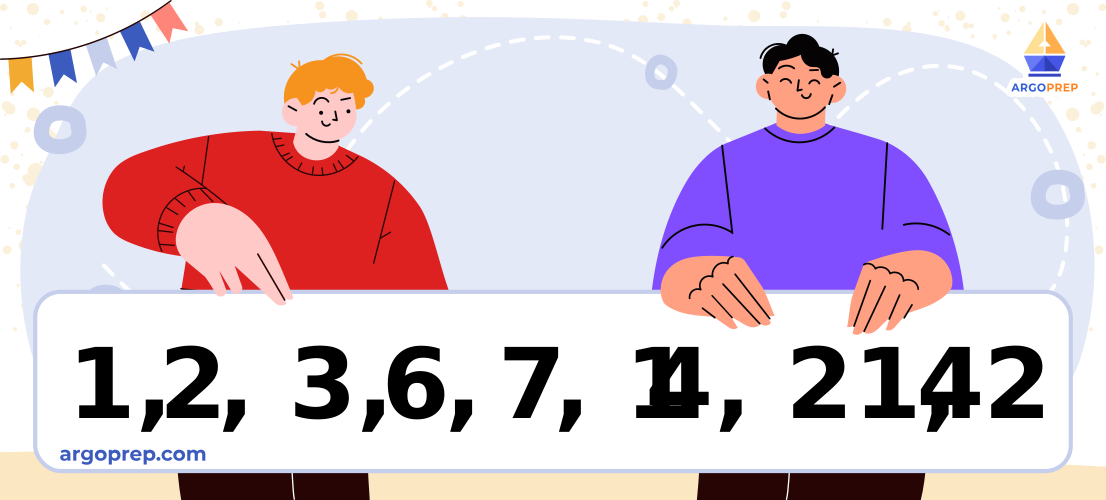
Factors of 42 are 1, 2, 3, 6, 7, 14, 21 and 42
The factors of 42 can be determined by seeing what numbers can divide into 42 without having a remainder. In the factorization tree below, it shows the factors of 42. The tree will show the numbers that can divide into 42 without a remainder and it also will show its factor partner.

This is one factorization. It shows that 2 and 21 are factors of 42. We can also figure out that 3 times 2 equals 6, so 6 and 7 are factors as well. We could also use this factorization tree by multiplying 7 times 2. This would be 14, so 3 and 14 are factors of 42.
Therefore, the factors are 1, 2, 3, 6, 7, 14, 21, and 42.
With the job that had 42 applicants apply for it, they were separated into three groups: above average, average, and below average. So, there were three groups. The factor that could be multiplied to 3 in order to equal 42 is 14. So, there are 14 applications in each group.
Challenging Questions
Question 1List the factors of 42
Which positive whole numbers divide 42 without leaving a remainder?
The factors of 42 are 1, 2, 3, 6, 7, 14, 21, 42.
Each listed number divides the original number evenly.
Question 2Find the factor pairs of 42
Which multiplication pairs have a product of 42?
42 has these positive factor pairs: 1 × 42; 2 × 21; 3 × 14; 6 × 7.
Multiplying the two numbers in any pair gives the original number.
Question 3Prime-factorize 42
What is the prime factorization of 42?
42 = 2 × 3 × 7.
Every number in the product is prime.