
Do you ever scratch your head and wonder how your child maintains above-average grades, but they never seem to study or turn in work? You may have a verbal learner on your hands!
As a verbal learner myself, I have often reaped the benefits and suffered the consequences of this specific learning style.
Passionate about words, the verbal learner is ready to tackle heavy reading assignments, challenging writing assignments, and will soar in a lecture.
They will enjoy the witty banter of Shakespeare and will relish in a challenging word problem. But don't give them too many abstract puzzles, or they will disengage immediately!
 In Math classes, verbal learners love a word problem over a simple equation. However, they will do the best in their English courses. These are the places that they can give speeches, debate, write, and reason all through the written and spoken word.
Verbal learners will continue to universities and continue to thrive in large lecture halls where they can listen to professors teach.
In the elementary classroom, a verbal learner will enjoy the stories and teaching from their classroom teachers.
They will like the directions provided with worksheets and may ask you to read through them again to ensure they are understanding.
The hardest part for a verbal learner in the elementary classroom is focusing on the tasks at hand long enough to get clear information to begin work.
[workbook=13474][workbook=12135][workbook=12185]...
In Math classes, verbal learners love a word problem over a simple equation. However, they will do the best in their English courses. These are the places that they can give speeches, debate, write, and reason all through the written and spoken word.
Verbal learners will continue to universities and continue to thrive in large lecture halls where they can listen to professors teach.
In the elementary classroom, a verbal learner will enjoy the stories and teaching from their classroom teachers.
They will like the directions provided with worksheets and may ask you to read through them again to ensure they are understanding.
The hardest part for a verbal learner in the elementary classroom is focusing on the tasks at hand long enough to get clear information to begin work.
[workbook=13474][workbook=12135][workbook=12185]...
 As mentioned above, finding or doing a crossword to reinforce spelling words or even finding a veteran to talk with your child about a war they are learning about in school will be far more valuable to them than a craft project.
Verbal learners will do well with online tutorials or videos explaining concepts as they age into more challenging content.
If your child is learning something that you are unsure of, make sure to use the internet as a resource to help you both understand.
Encourage your verbal learner to pursue extracurriculars such as Speech and Debate or FBLA.
Seek out opportunities where they can use their writing and words and watch them thrive!
As mentioned above, finding or doing a crossword to reinforce spelling words or even finding a veteran to talk with your child about a war they are learning about in school will be far more valuable to them than a craft project.
Verbal learners will do well with online tutorials or videos explaining concepts as they age into more challenging content.
If your child is learning something that you are unsure of, make sure to use the internet as a resource to help you both understand.
Encourage your verbal learner to pursue extracurriculars such as Speech and Debate or FBLA.
Seek out opportunities where they can use their writing and words and watch them thrive!
 Verbal learners also love word searches and crosswords. Consider using these for spelling words or recalling facts in social studies.
Your verbal learner will thank you for it! They will love listening to a storyteller or reading firsthand accounts of historical events.
They are incredibly observant and will enjoy watching a seasoned public speaker.
When they are watching field experts, they are mentally taking notes on how to improve their own skills.
Verbal learners also love word searches and crosswords. Consider using these for spelling words or recalling facts in social studies.
Your verbal learner will thank you for it! They will love listening to a storyteller or reading firsthand accounts of historical events.
They are incredibly observant and will enjoy watching a seasoned public speaker.
When they are watching field experts, they are mentally taking notes on how to improve their own skills.
Characteristics of a Verbal Learner
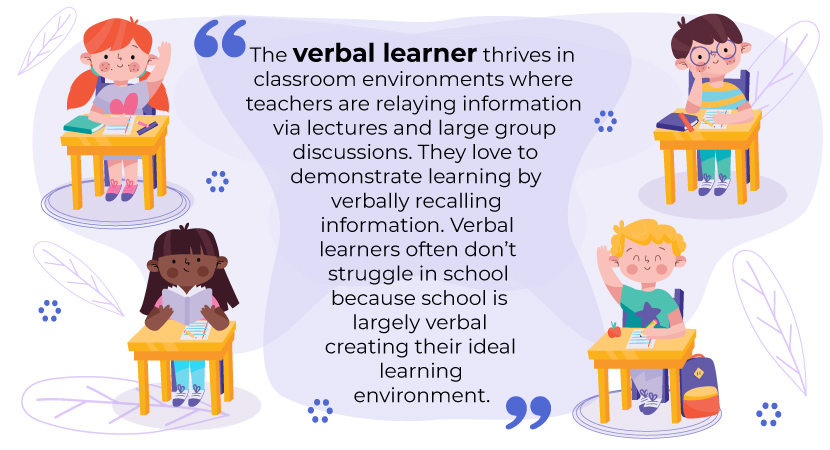
The verbal learner thrives in classroom environments where teachers are relaying information via lectures and large group discussions. They love to demonstrate learning by verbally recalling information. Verbal learners often don't struggle in school because school is primarily verbal, creating their ideal learning environment.
In Math classes, verbal learners love a word problem over a simple equation. However, they will do the best in their English courses. These are the places that they can give speeches, debate, write, and reason all through the written and spoken word.
Verbal learners will continue to universities and continue to thrive in large lecture halls where they can listen to professors teach.
In the elementary classroom, a verbal learner will enjoy the stories and teaching from their classroom teachers.
They will like the directions provided with worksheets and may ask you to read through them again to ensure they are understanding.
The hardest part for a verbal learner in the elementary classroom is focusing on the tasks at hand long enough to get clear information to begin work.
[workbook=13474][workbook=12135][workbook=12185]...
Common Struggles for the Verbal Learner
A verbal learner will struggle with abstract concepts. They tend to have a difficult time understanding math and will require additional support and information to learn concepts. It can sometimes be a struggle if there are not enough instructions to correspond with assignments. They may need to work closely with a teacher to understand the specifics of an assignment to complete it correctly. Verbal learners also do not enjoy the process of working with their hands, finding the work to be difficult, and the results not as gratifying as that of a debate or writing an essay. A verbal learner will need to work hard to establish rapport with teachers to communicate their needs when they arise. They enjoy rubrics, written directions (that are clear and not strayed from), and will follow up when the need arises. [subscribe=20543] Another unsavory result of being a verbal learner? Many won't struggle with school, becoming accustomed to passing assessments with ease. Their overconfidence may create some problems as they progress through school and begin not as easily to thrive in academic settings. They may even have to learn how to study and what information to retain!Applying Learning Style at School
As mentioned above, a verbal learner tends to have it "easier" in a school setting, since many classrooms are geared towards a traditional method of instructional delivery (think lectures, discussions, even flipped classrooms). A verbal learner tends to be able to stay on track and understand the material with ease. Classes that a verbal learner may struggle with can include music, art, woodworking/mechanics, math, and science courses. Any class that emphasizes abstract thought or working with their hands over the traditional delivery methods could present a problem for a verbal learner.Applying Learning Style at Home
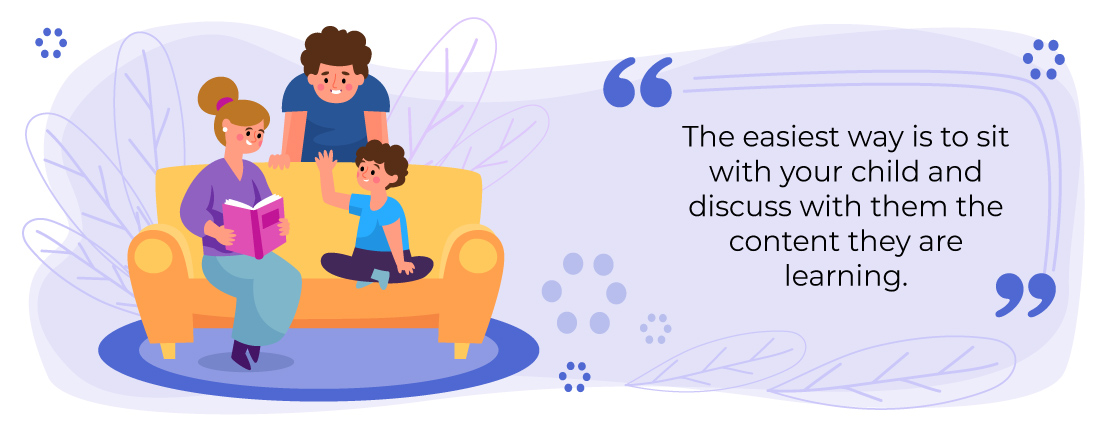
There are many ways that you can encourage a verbal learner at home. The easiest way is to sit with your child and discuss what they're learning with them. If they are struggling with a new math problem, try talking it through with them or rereading the directions with them. When children are working with somebody else, they tend to understand directions more clearly.
As mentioned above, finding or doing a crossword to reinforce spelling words or even finding a veteran to talk with your child about a war they are learning about in school will be far more valuable to them than a craft project.
Verbal learners will do well with online tutorials or videos explaining concepts as they age into more challenging content.
If your child is learning something that you are unsure of, make sure to use the internet as a resource to help you both understand.
Encourage your verbal learner to pursue extracurriculars such as Speech and Debate or FBLA.
Seek out opportunities where they can use their writing and words and watch them thrive!
Engaging Activities for Verbal Learners
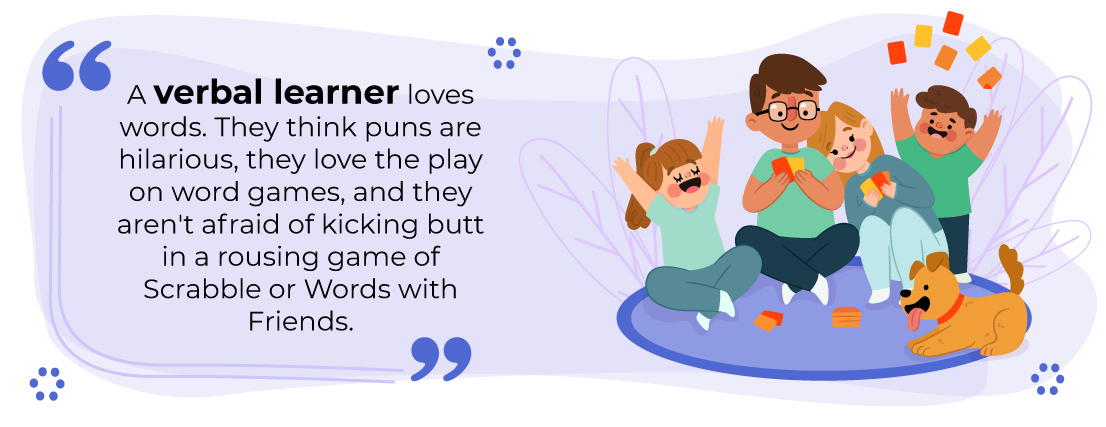
A verbal learner loves words. They think puns are hilarious. You may notice that your child loves to play word games and they aren't afraid of kicking butt in a rousing game of Scrabble or Words with Friends. They sometimes will become known by their friends as the nitpicker of grammar faux pas'. They aren't afraid to let you know when your words are being misused.
Verbal learners also love word searches and crosswords. Consider using these for spelling words or recalling facts in social studies.
Your verbal learner will thank you for it! They will love listening to a storyteller or reading firsthand accounts of historical events.
They are incredibly observant and will enjoy watching a seasoned public speaker.
When they are watching field experts, they are mentally taking notes on how to improve their own skills.