
Kids not doing homework? Welcome to the family.
As a teacher and parent, I know one thing for sure—most kids HATE doing homework. Honestly, I can’t blame them. After 8 plus hours of being stuck in a classroom, the last thing a kid wants to do is come home and do more schoolwork.
They have been sitting still all day and would love nothing more than to come home and play. If they choose to do that, though, they could end up receiving no credit for their homework. This might result in a lower grade.
 Like you, as a concerned parent, I seem to always be looking for a way to convince my children to do their work. I’ve tried to coerce them, but when I do this, they usually speed through their homework so they can play instead. The assignment ends up full of mistakes, and the score earned is so low that they might as well have not done it at all. Also, they learn nothing from the assignment, making it a waste of time.
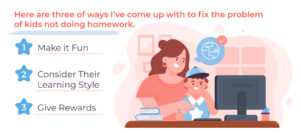
Here are three of ways I've come up with to fix the problem of kids not doing homework.
Like you, as a concerned parent, I seem to always be looking for a way to convince my children to do their work. I’ve tried to coerce them, but when I do this, they usually speed through their homework so they can play instead. The assignment ends up full of mistakes, and the score earned is so low that they might as well have not done it at all. Also, they learn nothing from the assignment, making it a waste of time.
Here are three of ways I've come up with to fix the problem of kids not doing homework.



Like you, as a concerned parent, I seem to always be looking for a way to convince my children to do their work. I’ve tried to coerce them, but when I do this, they usually speed through their homework so they can play instead. The assignment ends up full of mistakes, and the score earned is so low that they might as well have not done it at all. Also, they learn nothing from the assignment, making it a waste of time.
Here are three of ways I've come up with to fix the problem of kids not doing homework.
Kids Not Doing Homework? Make it Fun
When it comes to kids not doing homework it is usually due to their preoccupation with playing. So, why not let them play? This is probably a foreign concept. After all, past teachings say to limit distractions. However, allowing your child to do things they enjoy as they complete their work may be more helpful.Assuming the nature of the assignment is procedural, the negative effects of divided attention should be limited. Students can still get comfortable with processes like multiplication because they rely on the proper steps being followed rather than the retrieval of raw memory.
[subscribe=20543] For example, if your 3rd grader’s homework is to practice his or her multiplication facts, have your child write them in shaving cream or create problems using dice. This will be much more fun than writing them on paper or using boring flashcards. You might also consider an online program like ArgoPrep’s K-8 math. Because the program is based on educational standards, the activities will line up with what your child is learning at school. If he or she is required to practice spelling words every night, find multi-sensory alternatives to pencil and paper. Spelling with pipe cleaners, cereal, and creating puzzles with the words are all good options. If the assignment is structured, talk to your child’s teacher about alternatives. Most are willing to help!
Not Doing Homework: Consider Their Learning Style
Some children learn better by seeing (visual) while others need hands-on opportunity. My son, for example, is visual. He can look at a chart and instantly understand the information. My daughter, a singer, is an auditory learner but also retains information best when there is a musical component. Letting your child listen to music might motivate them to do their homework. No kid wants to sit in a quiet room and fill out a boring sheet of paper for hours on end. If their favorite songs are playing in the background, however, it starts to feel like less of a chore. Although, the possibility of them being distracted increases, the assignment will get done eventually. This is all that matters. Having the television on is an option as well, but it will probably be less effective. Television programs – especially cartoons – are full of distractions, such as pretty colors, loud noises, and interesting stories. While your child might enjoy them, they are very likely to get “sucked in” to the show. Then, you find yourself with the problem of kids not doing homework once again. An alternative might be to use videos or to let them work during commercial breaks. [workbook=14031][workbook=12185][workbook=12187]... Some children might also appreciate a meal while they are working. This is especially true of tactile learners who need to be “doing something.” Whether it is a small snack or a filling dinner, a plate of yummy food makes it easier to get through tedious assignments. Certain healthy foods lead to increased cognition and better mood, which can only be beneficial. Not only is this good for helping your child complete homework in the short-term, but it improves their long-term health, as well. Many students say it is their least favorite subject because it bores them. However, there are ways around this. We designed our program to make math more fun for kids. Kids love playing games and they love being on their electronic devices. Having them play electronic math games, then, makes learning more fun for them. If your kid(s) are not doing their homework, consider having them play a few games to see if they prefer an electronic means of learning.