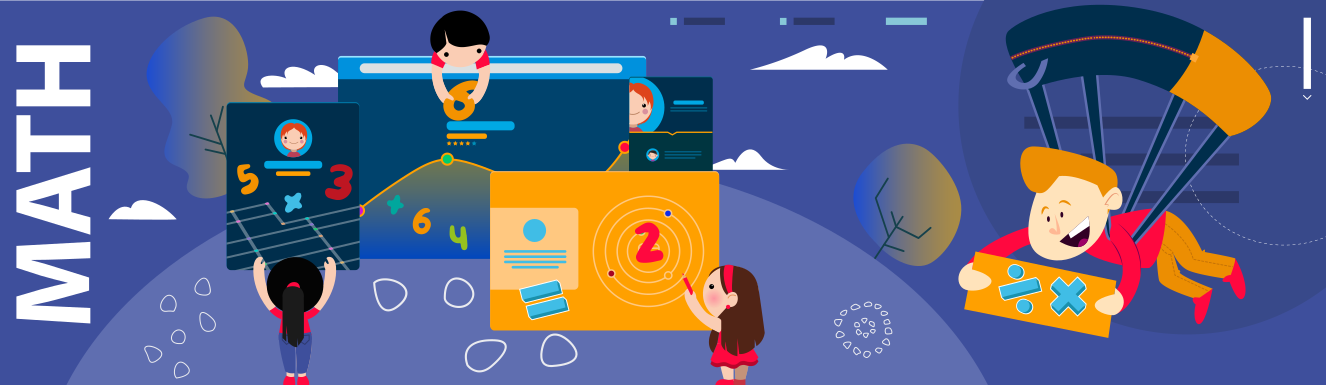

Logical learners are rational thinkers in the classroom. They enjoy a problem to solve and a goal to reach.
Logical learners can process through large amounts of data to achieve a result. But, logical learners also struggle with the skills covered in more creative classes such as English and Art (and even Social Studies!).
They can formulate solutions based on observing data and logically applying it.
In this series about learning styles, we are taking an in-depth view of all of the different learning styles in the classroom. By taking the time to understand each learning style, we have the keys to unlocking children and students more clearly.
The Logical Learner Defined
Logical learners are very detail-oriented and thoughtfully process through information logically.
They excel in math, physics, and computer science. Logical learners love the opportunity to solve a problem using facts and formulas to reach their conclusion. Logical learners can identify patterns with ease and will relish in the challenge of solving a puzzle.
They don't enjoy word problems as much as regular algebraic expressions.
Logical learners will contribute to group projects by creating agendas, notetaking, or implementing to-do lists to complete the work on time.
They love reports and spending time crafting the perfect spreadsheet complete with handwritten formulas.
[workbook=12141][workbook=13510][workbook=12189]...
Logical learners excel most when they are given hands-on projects with a specific goal in mind.
They do not enjoy "what if?" scenarios and don't find entertainment in hypothetical situations.
They do enjoy visual resources, creating apps, and have a knack for finding a good calculator.
The perfect classroom environment for a logical learner is structured and organized.
Consistency is key, and logical learners will not adapt to change quickly if the change is a cherished teacher or class.
[subscribe=20543]
 Logical learners enjoy the challenge of math, science, and computer science classes. They enjoy the process of working through a problem and coming up with a sequential process for understanding. In the classroom, they will excel in classes where there is a clear routine.
Classes, where teachers are more creative (for instance, using projects, role-playing, and traditional methods), may frustrate a logical learner because of its unpredictability.
Logical learners like clear due dates and, when confronted with a more significant project, will require short-term goals to complete in the process of reaching the finish line.
They will never miss an opportunity to find data and statistical information and will be an asset to groups working on projects with many steps.
Logical learners like rubrics, because it gives them a clear indication of exactly what they have to do to earn the grade they want.
Logical learners enjoy the challenge of math, science, and computer science classes. They enjoy the process of working through a problem and coming up with a sequential process for understanding. In the classroom, they will excel in classes where there is a clear routine.
Classes, where teachers are more creative (for instance, using projects, role-playing, and traditional methods), may frustrate a logical learner because of its unpredictability.
Logical learners like clear due dates and, when confronted with a more significant project, will require short-term goals to complete in the process of reaching the finish line.
They will never miss an opportunity to find data and statistical information and will be an asset to groups working on projects with many steps.
Logical learners like rubrics, because it gives them a clear indication of exactly what they have to do to earn the grade they want.
 Logical learners will jump at the opportunity to play games such as Uno, Monopoly, or dominoes.
They enjoy activities where they can research and plan events (vacations, date nights, etc.). Logical learners enjoy science experiments and like to get their hands on any experiments they can.
Activities that engage your logical learner include asking them to help you come up with a more efficient process for getting ready in the morning.
Or helping you with simple at-home setups of all of your automated devices. Logical learners love goal-oriented tasks (it's a bonus if it's technology-based!).
Logical learners will jump at the opportunity to play games such as Uno, Monopoly, or dominoes.
They enjoy activities where they can research and plan events (vacations, date nights, etc.). Logical learners enjoy science experiments and like to get their hands on any experiments they can.
Activities that engage your logical learner include asking them to help you come up with a more efficient process for getting ready in the morning.
Or helping you with simple at-home setups of all of your automated devices. Logical learners love goal-oriented tasks (it's a bonus if it's technology-based!).
The Logical Learner Defined

Logical learners are very detail-oriented and thoughtfully process through information logically.
They excel in math, physics, and computer science. Logical learners love the opportunity to solve a problem using facts and formulas to reach their conclusion. Logical learners can identify patterns with ease and will relish in the challenge of solving a puzzle.
They don't enjoy word problems as much as regular algebraic expressions.
Logical learners will contribute to group projects by creating agendas, notetaking, or implementing to-do lists to complete the work on time.
They love reports and spending time crafting the perfect spreadsheet complete with handwritten formulas.
[workbook=12141][workbook=13510][workbook=12189]...
Logical learners excel most when they are given hands-on projects with a specific goal in mind.
They do not enjoy "what if?" scenarios and don't find entertainment in hypothetical situations.
They do enjoy visual resources, creating apps, and have a knack for finding a good calculator.
The perfect classroom environment for a logical learner is structured and organized.
Consistency is key, and logical learners will not adapt to change quickly if the change is a cherished teacher or class.
[subscribe=20543]
Common Struggles for the Logical Learner
A logical learner will struggle in literature portions of an English class. While they will enjoy the process of writing a thesis and a 5-paragraph essay, the monotony of analyzing literature will be challenging for them. They also will struggle in courses such as art and PE, finding their time better spent working on creating a computer program. Logical learners could struggle with working in groups. If they are too focused on the goal and unwilling to entertain group member ideas, they can find themselves butting heads as they work through a project. This can be particularly difficult if working on a project in a subject area such as English.Applying Learning Style at School
Logical learners enjoy the challenge of math, science, and computer science classes. They enjoy the process of working through a problem and coming up with a sequential process for understanding. In the classroom, they will excel in classes where there is a clear routine.
Classes, where teachers are more creative (for instance, using projects, role-playing, and traditional methods), may frustrate a logical learner because of its unpredictability.
Logical learners like clear due dates and, when confronted with a more significant project, will require short-term goals to complete in the process of reaching the finish line.
They will never miss an opportunity to find data and statistical information and will be an asset to groups working on projects with many steps.
Logical learners like rubrics, because it gives them a clear indication of exactly what they have to do to earn the grade they want.
Applying Learning Style at Home
To best support your logical learner at home, think about ways to encourage their rational thought process. When it comes to homework, clear goals ("tonight read to page 45") are better than vague. If logical learners are looking for more activities at home, they will enjoy challenges that require them to research and compile data to reach a reasonable result. For the younger logical learner, you can bring in counting beads, an abacus, and counting bears. By using these educational aids, you will be able to support your child in building their math foundations.Engaging Activities for Logical Learners
Logical learners will jump at the opportunity to play games such as Uno, Monopoly, or dominoes.
They enjoy activities where they can research and plan events (vacations, date nights, etc.). Logical learners enjoy science experiments and like to get their hands on any experiments they can.
Activities that engage your logical learner include asking them to help you come up with a more efficient process for getting ready in the morning.
Or helping you with simple at-home setups of all of your automated devices. Logical learners love goal-oriented tasks (it's a bonus if it's technology-based!).