
Learning about multiples is one of the basic yet important concepts in mathematics. When we have mastered the concept of multiples, we will be able to confidently and competently tackle the more complex topics in mathematics.
This time, we will look into the multiples of another interesting number – the number 17. Aside from being a prime number, the number 17 is also the sum of the first four prime numbers, which are 2, 3, 5, 7. Moreover, it is the only prime number that is composed of consecutive prime numbers.

How awesome is that?
Are you now excited about another mathematical exploration of the multiples of 17? Gear up now because we will be digging in a whole new meaningful adventure to the world of multiples!

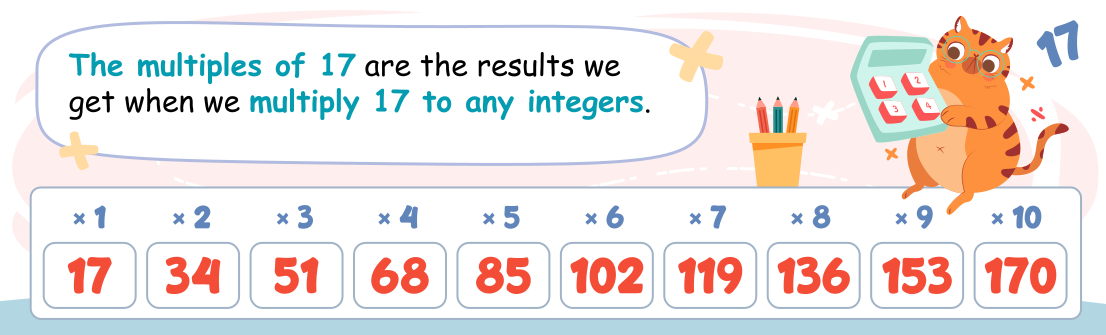
Multiples of 17 are 17, 34, 51, 68, 85, 102, 119, 136, 153
The multiples of a number are obtained by multiplying the number by another number. Multiples are commonly discussed in the context of integers. For example, the numbers 2, 4, 6, 8, and 10 are multiples of 2, which are obtained by multiplying 2 by the integers 1, 2, 3, 4, and 5, respectively.
Therefore, the multiples of 17 are the results we get when we multiply 17 to any integers.
Now, let us continue our mathematical exploration of how to find any multiples of 17!
How to find the multiples of 17?
Suppose n is a counting number. To get the nth multiple of 17, we must multiply 17 by n or add 17 n times. For example, if we want to determine the third multiple of 17, we must multiply 17 by 3, .
It is worth noting that consecutive multiples of 17 generate a number sequence in which the difference between two consecutive numbers is 17. Thus, the multiples of 17 can also be obtained by repeated addition of 17.
So, to find the third multiple of 17 by repeated addition, we can express it as 17 + 17 + 17 = 51. Hence, the third multiple of 17 is 51.
Let's look at the diagram below to see how easy it is to find multiples of 17 by repeated addition.
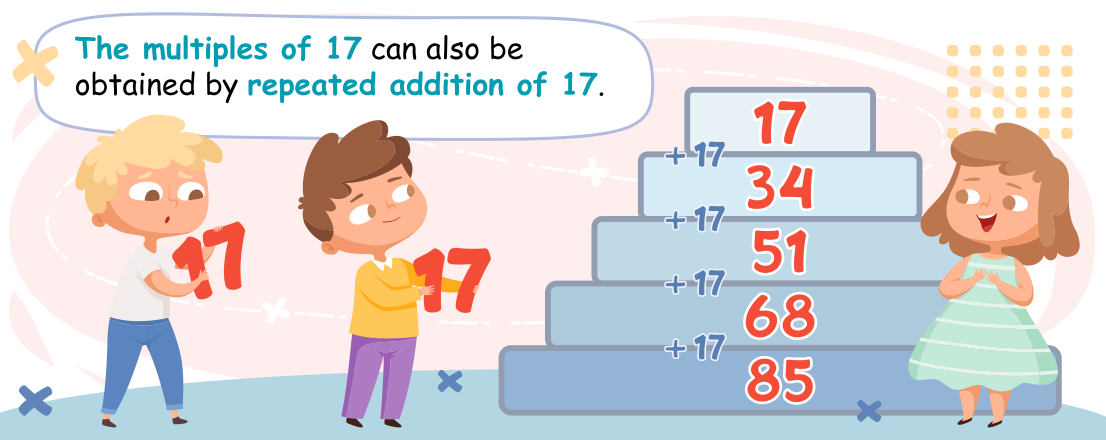
Isn't that easy? Let us try another example by finding the sixth multiple of 17.
By multiplication, the sixth multiple of 17 can be expressed as and by repeated addition as
17 + 17 + 17 + 17 + 17 + 17. Both methods resulted in 102. Thus, the sixth multiple of 17 is 102.
Now, look at how this table of getting the first five multiples of 17 by repeated addition and multiplication. They both have the same result, right?
| nth multiple of 17 | by Multiplication | by Repeated Addition |
|---|---|---|
|
1st multiple |
17 × 1 |
17 |
|
2nd multiple |
17 × 2 |
17 + 17 |
|
3rd multiple |
17 × 3 |
17 + 17 + 17 |
|
4th multiple |
17 × 4 |
17 + 17 + 17 + 17 |
|
5th multiple |
17 × 5 |
17 + 17 + 17 + 17 + 17 |
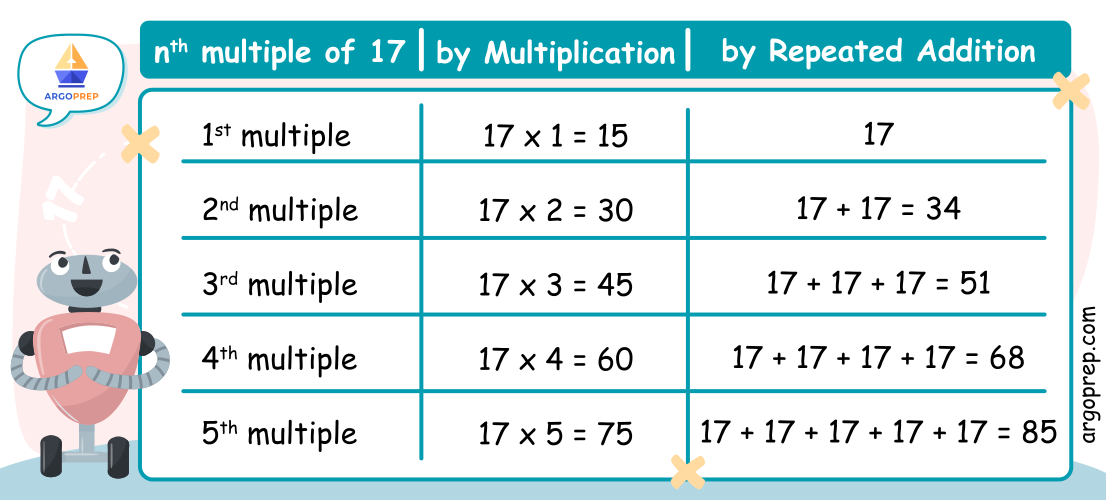
Now, you can efficiently find any number that is a multiple of 17!
But wait, we must keep in mind that when a multiple of a number is divided by that number, the result is always a whole number. For example, 153 is a multiple of 17, and if we divide it by 17, the result is 9, which is a whole number. Hence, we cannot use fractions to obtain multiples. Always remember that, okay?
List of the First 30 Multiples of 17
We have just learned that we can obtain the multiples of 17 by multiplying 17 to any integer. And since there are infinitely many integers, there are also infinitely many multiples of 17. The first 30 multiples of 17 obtained by multiplying 17 by the integers from 1 to 30 are listed in the table below
| Product of 17 and a positive counting number | Multiples of 17 |
|---|---|
|
17 × 1 |
17 |
|
17 × 2 |
34 |
|
17 × 3 |
51 |
|
17 × 4 |
68 |
|
17 × 5 |
85 |
|
17 × 6 |
102 |
|
17 × 7 |
119 |
|
17 × 8 |
136 |
|
17 × 9 |
153 |
|
17 × 10 |
170 |
|
17 × 11 |
187 |
|
17 × 12 |
204 |
|
17 × 13 |
221 |
|
17 × 14 |
238 |
|
17 × 15 |
255 |
|
17 × 16 |
272 |
|
17 × 17 |
289 |
|
17 × 18 |
306 |
|
17 × 19 |
323 |
|
17 × 20 |
340 |
|
17 × 21 |
357 |
|
17 × 22 |
374 |
|
17 × 23 |
391 |
|
17 × 24 |
408 |
|
17 × 25 |
425 |
|
17 × 26 |
442 |
|
17 × 27 |
459 |
|
17 × 28 |
476 |
|
17 × 29 |
493 |
|
17 × 30 |
510 |
Did you know that…
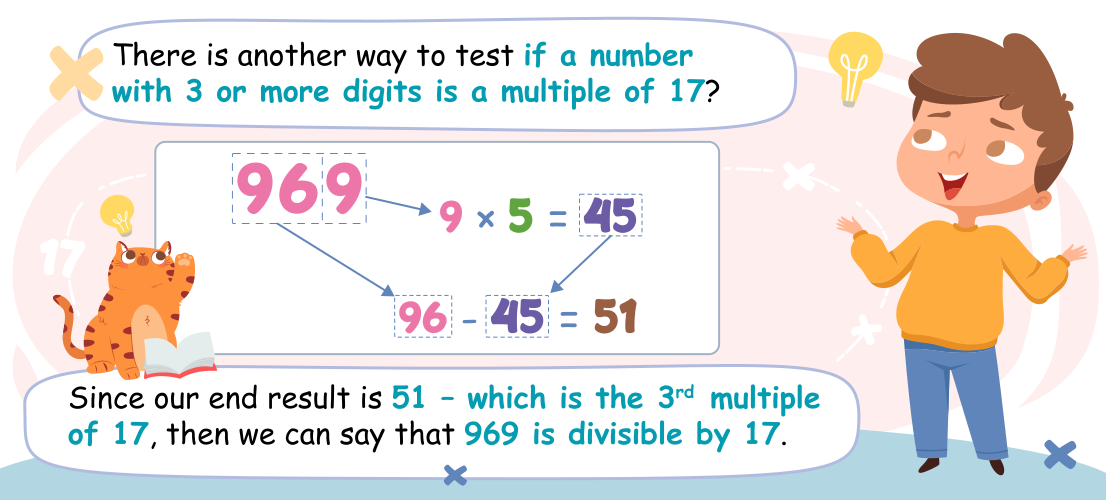
There is another way to test if a number with 3 or more digits is a multiple of 17? We just need to follow the simple steps below.
- Multiply the last digit by 5.
- Subtract the obtained product from the rest of the digits.
- If the result from the previous step is divisible by 17, then the number is a multiple of 17.
Let us consider the number 969. The first step is to multiply the last digit by 5 so, . Next, we will subtract 45 from the remaining digits so, 96 – 45 = 51. Since our end result is 51 – which is the 3rd multiple of 17, then we can say that 969 is divisible by 17.
You may also try this to other numbers and see for yourself that this method works.
What a cool thing to know!
Problems involving multiples of 17
The time has come for you to put what we have learned about the multiples of 17 into practice by answering the following real-life problems!
Problem #1
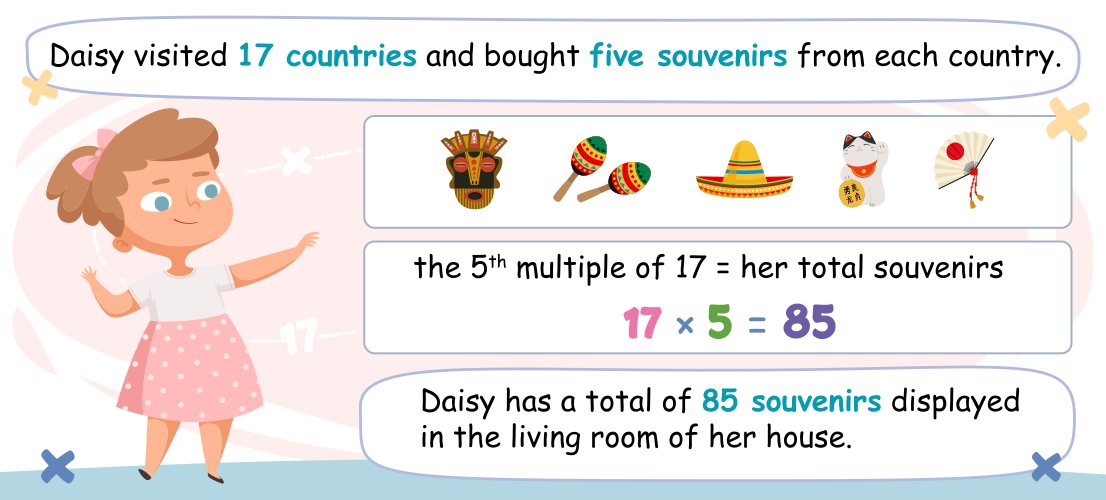
Daisy loves traveling in different countries and collecting souvenirs. In each of the countries she visited, she always bought five different souvenirs. These souvenirs are being displayed in the living room of her house. If she has been to 17 different countries already, how many souvenirs did she collect in total?
To solve this, we must take note that Daisy visited 17 countries and bought five souvenirs from each country. So, we must find the 5th multiple of 17 to determine her total souvenirs. To do this, we simply multiply 17 by 5. Thus, .
Therefore, Daisy has a total of 85 souvenirs displayed in the living room of her house.
Did you get the same answer? Now let us try to solve another problem.
Problem #2
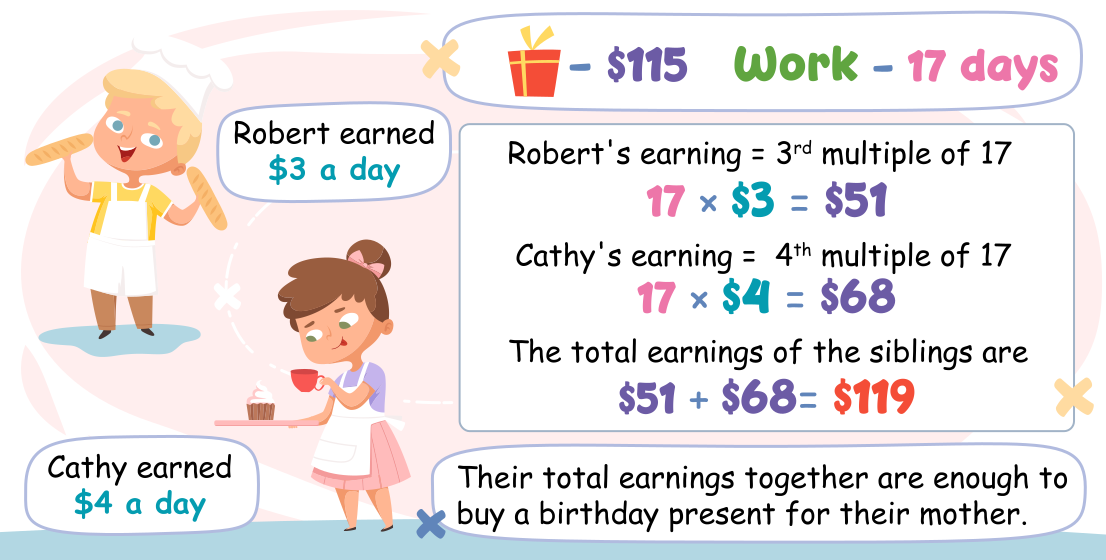
Robert and his sister, Cathy, want to save $115 for their mother's birthday present. They decided to have a part-time job during the summer break. Robert worked in a bakery where he earned $3 a day. Cathy worked in a coffee shop and earned $4 a day. If both of them worked for 17 days, would their total earnings together be enough to buy a birthday present for their mother?
To solve this, we must first compute the earnings of each of the siblings.
Robert's earning is given by the 3rd multiple of 17. So, . Thus, Robert earned $51.
Cathy's earning is given by the 4th multiple of 17, which can be expressed as . Thus, Cathy earned $68.
Next, we must combine the earnings of both siblings. So, 51 + 68 = 119. Hence, the total earnings of the siblings are $119, which is already greater than their target amount of $115.
Therefore, their total earnings together are enough to buy a birthday present for their mother.
Excellent! Knowing about the multiples of 17 are really useful in solving real-world problems, I'm sure you agree.
Take a quiz
Now that you have learned the concept of multiples of 17, it is time for you to put your newfound knowledge to the test by answering the following questions.
Question 1Recognize multiples of 17
What are the first five positive multiples of 17?
17, 34, 51, 68, 85.
They are found by multiplying 17 by 1, 2, 3, 4, and 5.
Question 2Continue the sequence
What comes after 85 in the sequence of positive multiples of 17?
102.
Add 17 to 85.
Question 3Check a multiple
Is 136 a multiple of 17?
Yes. 136 = 17 × 8.
A number is a multiple when it is the product of the original number and an integer.
Question 4Use division to verify
How can division confirm that 153 is a multiple of 17?
153 ÷ 17 = 9, with no remainder.
A whole-number quotient confirms the multiple.